Mario's Picross — The Game Boy Puzzle That Taught a Generation to Think in Numbers
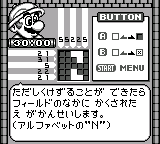
Before Picross became a fixture on every Nintendo handheld, it started here: a quiet Game Boy cartridge in which Mario swaps his wrench for a chisel and uncovers pictures hidden inside grids of numbers. Mario's Picross is a pure logic game — no jumping, no enemies to stomp — and that focus is exactly why it still holds up. If you enjoy Sudoku, crosswords, or any puzzle you solve by proof rather than reflexes, this is an essential piece of handheld history.
Quick Facts
| Item | Details |
|---|---|
| Original title | マリオのピクロス (Mario no Picross) |
| English title | Mario's Picross |
| Platform | Game Boy |
| Release date | March 14, 1995 (Japan) |
| Developer | Jupiter / Ape Inc. |
| Publisher | Nintendo |
| Genre | Puzzle (nonogram / picture logic) |
| Cartridge size | 256 KB |
| Save method | Battery-backed save (MBC1 + RAM + Battery); Super Game Boy enhanced |
Overview
A picross puzzle — also called a nonogram — presents you with an empty grid and a set of numbers along the top and left edges. Each number tells you how many consecutive squares must be chiselled in that row or column. Two numbers mean two separate runs, with at least one blank square between them. Work the rows and columns against each other, mark squares that must stay empty with an X, and a picture gradually emerges: food, animals, everyday objects, and the occasional Mario-series cameo.
The framing is light and charming. Mario appears as an archaeologist, reading pictures carved into ancient stone tablets, and his face in the corner of the screen reacts as you play — pleased when the picture is completed, dismayed when time runs out. There is no story to follow and nothing to unlock outside the puzzle courses themselves, which keeps the game easy to pick up for five minutes or an hour.
Mario's Picross contains 256 puzzles in total. That was a generous amount of content for a 1995 handheld game, and it is structured so that a complete beginner can start at the smallest 5×5 grids and finish, many hours later, on full 15×15 boards.
Why It Still Matters
This cartridge launched Nintendo's Picross series, which later continued through Picross DS, the Picross e series on Nintendo 3DS, and the Picross S series on Nintendo Switch. Jupiter, its lead developer, went on to make most of the series. Playing the original shows how much of the formula was already right in 1995: a gentle tutorial course, a strict but fair penalty system, and a final mode that removes every safety net.
It is also a revealing piece of 1990s publishing history. The game sold well in Japan, but despite television commercials and magazine coverage it sold poorly in North America and Europe. Its two sequels — Mario's Super Picross for the Super Famicom and Picross 2 for the Game Boy — were therefore released only in Japan, and English-speaking players did not get another Nintendo picross game until Picross DS in 2007. The Game Boy original has since been reassessed as a cult classic, and its modern re-releases have made it far easier to find than it was for years.
Highlights
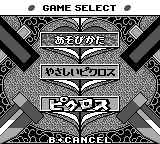
- A complete logic course in one cartridge: 256 puzzles, rising from 5×5 teaching boards to demanding 15×15 pictures.
- Mistakes have real weight: in the standard courses a wrong chisel costs minutes, so careful deduction beats guessing — see the penalty table below.
- Two ways to play: the standard courses check your work as you go, while Time Trial gives you no feedback at all and simply records how fast you were.
- Built for handheld sessions: battery-backed saving records your clear times, and puzzles can be tackled in any order within the first three courses.
Strategy Essentials
Courses
| Course | Puzzles | Grid size | Availability and notes |
|---|---|---|---|
| Easy Picross | 64 (Levels 1–8, puzzles A–H) | Level 1: 5×5; Levels 2–6: 10×10; Levels 7–8: 15×15, partly in a reduced-width form | Available from the start; any puzzle can be played in any order |
| Kinoko Course | 64 (Levels 1–8, puzzles A–H) | 15×15 | Available from the start; any puzzle can be played in any order |
| Star Course | 64 (Levels 1–8, puzzles A–H) | 15×15 | Unlocks after all Kinoko Course puzzles are completed |
| Time Trial | 64, presented in random order | 15×15 | Unlocks after all Star Course puzzles are completed |
The 256 Puzzles, Broken Down by Grid Size
| Grid size | Puzzles | Where they appear |
|---|---|---|
| 5×5 | 8 | Easy Picross, Level 1 |
| 10×10 | 40 | Easy Picross, Levels 2–6 (5 levels × 8 puzzles) |
| 15×15 | 208 | Easy Picross, Levels 7–8 (16; some use a reduced playing area); Kinoko Course (64); Star Course (64); Time Trial (64) |
| Total | 256 |
Read this way, the cartridge is a staircase: 48 teaching puzzles on smaller boards, then 208 full-size puzzles. If you are new to picross, do not skip the small boards — the techniques below are all introduced there at a size where you can see the whole puzzle at once.
Rules and Penalties at a Glance
| Rule | Easy / Kinoko / Star | Time Trial |
|---|---|---|
| Time limit | 30 minutes per puzzle | None — the timer counts up from zero |
| Wrong chisel | 1st mistake: −2 minutes; 2nd: −4 minutes; 3rd and later: −8 minutes each | Not flagged; no time penalty |
| Wrong X mark | No penalty | No penalty |
| Hint | Optional "With Hint" roulette at the start reveals one full row and one full column; a hint-assisted clear is recorded with an "H" | No hints |
| Running out of time / finishing | Time out is game over; restart the puzzle | Completion time can be entered on a high-score board with your initials |
Solving Techniques, from First Moves to Last Resort
Work through these stages in order. Most puzzles in Easy Picross and the Kinoko Course fall to Stages 1–3 alone; Star Course and Time Trial regularly demand Stages 4–5.
| Stage | Technique | How it works | When to use it |
|---|---|---|---|
| 1 | Full and near-full lines | A single clue equal to the grid size (15 on a full board) fills the whole line. A clue of 15 on a 15-wide line, or several clues summing — with the mandatory gaps — to the full width, leave no freedom at all | The opening scan of every puzzle |
| 1 | Overlap (intersection) | Push a run as far left as it can go, then as far right. Any square it covers in both positions is certain. A run of 10 on a 15-wide line, for example, always covers the middle squares | Immediately after Stage 1, on the largest clues |
| 2 | Counting from the edge | If the first square of a line is filled, the first run starts there: count out its full length, then X the square after it. The same works in reverse from the far edge | Whenever a filled square touches an edge |
| 2 | Completing a line | Once a line's filled squares exactly match its clues, every remaining square in that line becomes an X. This is the most productive move in the game — each X is a new fact for the crossing line | The moment any line is finished |
| 3 | Row–column linkage | Treat every deduction as belonging to two lines at once. A single X placed in a column can shrink a run's possible positions in that column, creating a new overlap there, which feeds back into its row | Continuously, after every placement |
| 3 | Gap accounting | Between two runs there is at least one blank. If placing a run at its earliest position already forces the next run past the line's end, the first run must start later — the squares it cannot reach become X's, and the squares it must cover become fills | When a line has two or more clues and feels "almost" determined |
| 4 | Comparing neighbouring lines | Look at two adjacent rows (or columns) with similar clues together. A filled square in one often forces the matching square in the other, because pictures rarely change by one isolated square — but only commit when a crossing line proves it, not on the picture's look | Mid-game, when single-line logic stalls |
| 4 | Corner and edge clusters | Runs near a corner are constrained from two directions at once. Checking the short lines around a corner frequently unlocks a whole quadrant | When the centre is stuck but an edge region is untouched |
| 5 | The assumption method (proof by contradiction) | Choose a line with exactly two possible arrangements. Mentally follow one arrangement's consequences through the crossing lines. If it produces a contradiction — a line that can no longer fit its clues — the other arrangement is correct | Only after Stages 1–4 produce nothing. In the standard courses, work the assumption out without chiselling: a wrong chisel is what costs minutes. Follow the chain only as far as you must, then play the proven squares for real |
Playing the No-Feedback Rules: Time Trial (and "Wario's Picross")
One point that often causes confusion: this Game Boy cartridge has no mode actually named "Wario's Picross." A mode by that name, built on the same no-limit, no-feedback idea as Time Trial, appears in the sequels Mario's Super Picross and Picross 2. If you want that stricter style of play in this game, Time Trial is where you will find it — and the approach below applies to Wario's Picross in those sequels as well.
Removing the penalty changes the game completely, so change how you play:
- Your errors stop announcing themselves. In the standard courses a wrong chisel is corrected for you at a price; here it simply sits there, quietly corrupting every later deduction in its row and column. Accuracy matters more than speed, even though the clock is running.
- Finish lines decisively. The completed-line check (Stage 2) is your only "referee": once a line's filled squares match its clues exactly, X everything else in it. A line you leave "probably finished" is where mistakes hide.
- Solve in passes, not in areas. Sweep the whole board for certain squares, then sweep again. Staring at one region encourages the kind of local guess that no-feedback rules punish most.
- If everything stops adding up, suspect the earliest uncertain square. Contradictions surface far from their cause. Backtrack to the last square you placed without full proof, X it, and rebuild from there.
- Use the assumption method freely — but track it. With no time penalty, testing a two-way choice costs nothing if you remember which squares depended on the assumption. Keep assumed squares mentally grouped; if a contradiction appears, every one of them comes out, not just the last.
Mistake Management: Playing Against the Penalty Clock
In the standard courses, the clock — not the puzzle — is your real opponent. The penalties escalate, and they compound:
| Mistakes so far | Penalty for this mistake | Total time lost | Time left from 30:00 (before solving time) |
|---|---|---|---|
| 1st | −2 minutes | 2 minutes | 28:00 |
| 2nd | −4 minutes | 6 minutes | 24:00 |
| 3rd | −8 minutes | 14 minutes | 16:00 |
| 4th | −8 minutes | 22 minutes | 8:00 |
In practice, a fifth wrong chisel leaves almost every player out of time, so treat four mistakes as the effective limit. Habits that keep you inside it:
- No proof, no chisel. Before filling any square, say — literally, if it helps — which clue forces it. If the answer is "it looks right," it is a guess, and guesses are what the penalty table prices.
- X is free armour. Marking a square with X never costs time, even when the X itself turns out to be wrong. Use X's to fence off finished runs and impossible positions before you commit to fills nearby.
- Spend the hint deliberately. The opening hint roulette reveals a full row and column — a safe skeleton to build from — and a hint-assisted clear is only marked with an "H" in your records. For a first attempt at a hard Star Course puzzle, that trade is usually worth it; save no-hint clears for the replay.
- Watch the clock at natural breaks. After finishing each region of the picture, glance at the timer. If two mistakes are already gone (−6 minutes) and half the board is unsolved, slow down: the remaining puzzles' deductions are worth more than the seconds saved by rushing.
- Know when to restart. Two early mistakes on a large puzzle can make a clean restart the cheaper option — a fresh 30:00 costs less than solving for 16:00 with a damaged board. Restarting is a strategy, not a surrender.
Solving Habits That Work
- Start with the biggest numbers. A clue close to the full width of the grid forces most of its squares, and a single-number clue equal to the grid size fills the entire line.
- Use the overlap method. Slide a run to both extremes of its line in your head; any square it covers in both positions must be filled.
- Mark X early and often. A square you have proved empty is information. X marks cost nothing, even if you later find one was wrong.
- Cross-reference constantly. Every filled or crossed square in a row is a new clue for its column, and vice versa. Alternate direction after every deduction.
- Respect the gap. Between two runs there is always at least one blank square — forgetting this is the most common beginner error.
- Do not guess in the standard courses. With penalties rising to −8 minutes, a guess can end a puzzle. Work another line and let the answer become provable.
- In Time Trial, slow down at the end. Nothing tells you a square is wrong, so before finishing, re-check any line whose numbers only "mostly" fit.
Who It's For
Mario's Picross suits players who like logic puzzles with definite answers, fans of Sudoku and crosswords looking for a pictorial cousin, and retro collectors who want the starting point of a long-running Nintendo series. It is less suited to players who want action, large grids — the Game Boy screen caps puzzles at 15×15 — or a story. Complete beginners are genuinely welcome here: Easy Picross teaches the rules puzzle by puzzle.
How to Play It Today
As of November 2026, the easiest official route is Game Boy – Nintendo Classics on Nintendo Switch, where Mario's Picross was added in March 2025 (March 6, 2025 in North America; March 7, 2025 in Japan and Europe) for Nintendo Switch Online members. The game was also sold on the Nintendo 3DS Virtual Console — released July 14, 2011 in Europe, August 4, 2011 in North America, and September 21, 2011 in Japan — although, as of November 2026, the Nintendo 3DS eShop has closed, so that version is only available to those who already purchased it. In Japan, the game was also reissued in 2000 for the Nintendo Power cartridge-writing service.
Original Game Boy cartridges remain common on the second-hand market, and the Japanese and overseas versions play identically in structure. If you shop for a physical copy, you can compare current listings here:
Find the original Japanese cartridge
Disclosure: The Rakuten and Yahoo! Shopping links are standard shopping links. Enkeisha does not earn a commission from purchases made through these links.
Find original hardware editions on eBay
As an eBay Partner Network affiliate, Enkeisha may earn a commission from qualifying purchases made through these links.
Search eBay listings (affiliate link)
Check the language, region, hardware compatibility, condition and authenticity before buying. Search results may include reproductions; links do not endorse individual sellers.