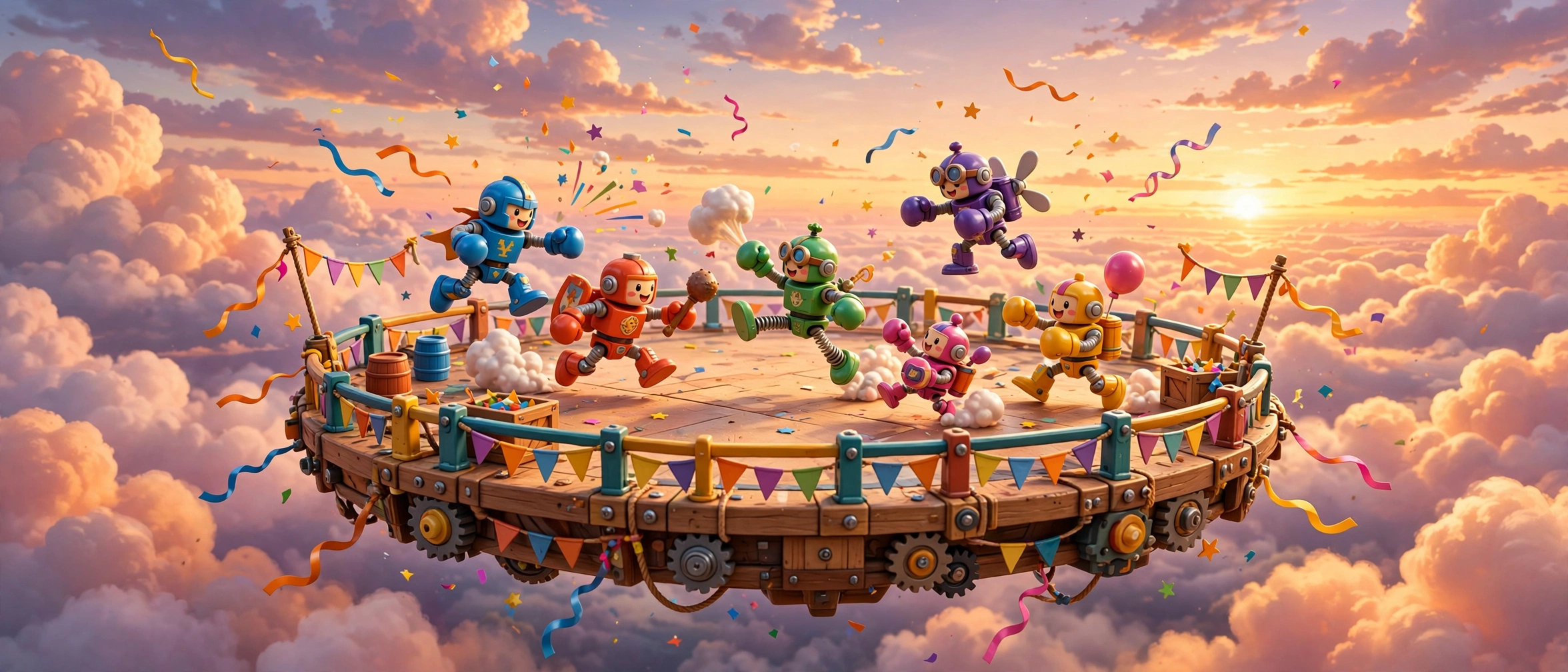
Twelve Nintendo characters, nine stages, and one idea nobody had tried before: a fighting game where you do not drain a health bar — you raise a percentage and knock your opponent off the stage. Super Smash Bros. began as a small, low-budget side project at HAL Laboratory and became the founding document of the platform fighter. This is a deep strategy guide to the 1999 original: the full roster and exactly how the four hidden fighters are unlocked, the fixed 14-stage ladder of the 1P Game, and the damage-percentage maths that decides every match.
Quick facts
| Item | Detail |
|---|---|
| Original title | ニンテンドウオールスター!大乱闘スマッシュブラザーズ (Nintendō Ōrusutā! Dairantō Sumasshu Burazāzu) |
| English title | Super Smash Bros. |
| Platform | Nintendo 64 |
| Release date (Japan) | January 21, 1999 |
| Developer | HAL Laboratory |
| Publisher | Nintendo |
| Director | Masahiro Sakurai |
| Genre | Platform fighting game (1–4 players) |
Overview
The core rule is a deliberate inversion of the fighting-game template of its era. Attacks do not reduce a life gauge. Instead, every hit raises the victim's damage percentage, and the higher that number climbs, the farther the victim flies when struck. A fighter at 10% barely moves; the same fighter at 120% can be launched off the screen by a single strong smash attack. Victory is a ring-out: push the opponent past the stage's blast lines — top, sides or bottom — and take a stock. Because of this, position is the real resource. Holding the centre of the stage is worth more than any combo, and a fighter hanging off the edge is already half beaten.
Each fighter has a compact move set by modern standards: standard attacks, tilt attacks, three smash attacks performed by flicking the stick and pressing the attack button at the same time (smash attacks cannot be charged in this game), aerial attacks, throws, a shield, and three special moves (neutral, up and down — side specials do not exist yet in this game). The up special is also the recovery tool, and learning each character's recovery distance is the first survival skill. Items fall onto the stage throughout a match — beam swords, home-run bats, Poké Balls, hammers, containers and food — and in this first game they are powerful enough to decide games on their own, which is part of its chaotic party identity.
The single-player offering is the 1P Game, a fixed ladder of 14 stages (detailed in the strategy section) that mixes one-on-one fights, team fights against multiples of one character, giant and metal opponents, three bonus stages (Break the Targets, Board the Platforms, Race to the Finish), a fight against the Fighting Polygon Team, and a final boss, Master Hand — a giant gloved hand who is the final boss of this game and has a health value rather than a damage percentage. A Training mode, the two bonus-stage modes playable standalone, and Versus for up to four players round out the package.
Why It Still Matters
This is the game that proved a fighting game could be built around movement and knockback instead of health bars and command lists — and that Nintendo's characters could share one arena without it feeling like a cheap cross-over. Director Masahiro Sakurai designed it as an accessible alternative to the increasingly technical arcade fighters of the 1990s: inputs are directional and readable, and a beginner who can jump and press a button is already playing the real game. Everything the series later became — the enormous rosters, the stage hazards, the items, the final smashes — is an expansion of decisions made here, on a small budget, with twelve fighters.
It also remains the most distinct-feeling entry. Hitstun is long, combos are heavy and inescapable in a way later games softened, throws are extremely strong, and the small roster means every matchup is knowable in an evening. Competitive players still run it for exactly that purity: there is nowhere to hide behind character volume.
Highlights
- The percentage system in its rawest form. No rage mechanics, no comeback systems — just damage, knockback and stage position, completely legible at a glance.
- A roster of twelve that covers the whole of 1990s Nintendo. Mario, Donkey Kong, Link, Samus, Yoshi, Kirby, Fox and Pikachu from the start; Luigi, Captain Falcon, Ness and Jigglypuff hidden.
- Nine Versus stages, each with a real gimmick. The moving platform of Peach's Castle, the tornadoes of Hyrule Castle, the rising acid of Planet Zebes, the Arwing that fires on Sector Z, and Pokémon emerging from the door on Saffron City.
- Master Hand. A boss with an actual health bar in a game that otherwise abolished them — the exception that closes every 1P run.
Strategy Essentials
1. The full roster — and how the four hidden fighters are unlocked
Eight fighters are available immediately. The other four each demand a specific feat in the single-player modes, after which the fighter challenges you to a one-stock match on a set stage: win, and they join the roster; lose, and you must meet the condition again.
| Fighter | Available | How to unlock (then win the challenge match) |
|---|---|---|
| Mario | From the start | — |
| Donkey Kong | From the start | — |
| Link | From the start | — |
| Samus | From the start | — |
| Yoshi | From the start | — |
| Kirby | From the start | — |
| Fox | From the start | — |
| Pikachu | From the start | — |
| Jigglypuff | Hidden | Clear the 1P Game with any fighter, on any difficulty |
| Captain Falcon | Hidden | Clear the 1P Game in under 20 minutes, with any fighter |
| Ness | Hidden | Clear the 1P Game on Normal difficulty or higher, with 3 stock or fewer, and without using a continue |
| Luigi | Hidden | Clear Break the Targets with all eight starting fighters |
The only unlockable stage follows a similar logic: clear the 1P Game with all eight starting fighters and play a Versus match on each of the eight starting stages to add Mushroom Kingdom — a side-scrolling-style stage built from the original Super Mario Bros. scenery, complete with POW Blocks and Piranha Plants — to Versus mode, bringing the Versus stage count to nine.
2. The 1P Game, stage by stage
The ladder never changes order. Knowing what is coming — especially where the bonus stages and the two "special body" fights sit — is how you budget your stock and your continues.
| Stage | Opponent / event | Stage used | What actually matters |
|---|---|---|---|
| 1 | Link | Hyrule Castle | A straightforward duel; learn the tornado's timing rather than fighting it |
| 2 | Yoshi Team (18 Yoshis, in waves) | Yoshi's Island | They fall in small groups and die early; throws and edge-guards clear waves fastest |
| 3 | Fox | Sector Z | Watch for the Arwing's shots; use the ship's tail as safe ground |
| Bonus 1 | Break the Targets | Character-specific | Each fighter has a unique target layout; this mode is also the road to Luigi |
| 4 | Mario Bros. (Mario + Luigi, 2-on-2 — you fight alongside one random CPU ally) | Peach's Castle | Work with your ally and isolate one brother at the bumper; keeping your ally alive matters |
| 5 | Pikachu | Saffron City | The Pokémon door on the right is a hazard and a weapon; fight on the left roofs |
| 6 | Giant Donkey Kong (3-on-1, you plus two allies) | Congo Jungle | Your allies do real work; stay alive and let numbers tell — the giant dies by percentage like anyone |
| Bonus 2 | Board the Platforms | Character-specific | Pure movement test; knowing your recovery move's height is the whole stage |
| 7 | Kirby Team (8 Kirbys, most wearing different copy hats) | Dream Land | Most Kirbys use one hat ability, but the final one is an exception — it is a plain Kirby, or a Kirby copying an unlockable fighter once unlocked; they are light and launch early — area attacks clear them |
| 8 | Samus | Planet Zebes | The acid rises on a cycle; the fight is about who owns the top platform when it does |
| 9 | Metal Mario | Meta Crystal (1P-only stage) | Metal Mario barely flinches at low percent; do not trade hits — build damage from range, then launch |
| Bonus 3 | Race to the Finish | Obstacle course | A timed run past enemies and hazards; reaching the finish is how you earn the bonus — if you fail or time out, you still move on to the next regular stage |
| 10 | Fighting Polygon Team (30) | Duel Zone (1P-only stage) | Polygon clones of the roster, individually weak; area attacks and throws, and do not get surrounded |
| Final | Master Hand | Final Destination (1P-only stage) | The one health-bar fight in the game; he has 300 HP on every difficulty |
3. Damage, knockback and the edge — the three habits that win
- Fight for the centre. Knockback distance grows with percentage, so the player nearer the edge is always closer to losing the stock. Concede the ledge, never the middle.
- Edge-guard instead of chasing KOs. At high percent, a weak aerial off-stage beats a smash attack on-stage: the opponent must spend their jump and up special to return, and hitting them during that recovery ends the stock.
- Respect throws and shields. Throws in this game are fast and strong, and a broken shield leaves a fighter stunned (for Jigglypuff, a shield break launches her upward outright). Shield to block a smash, then punish — do not shield out of habit in front of a grab-happy opponent.
Who It's For
Players who want the platform fighter in its most concentrated form: twelve fighters, heavy combos, and matches decided by positioning more than by move lists. It is also the essential historical stop — every later entry is a variation on this template — and as a four-player party game it has lost almost nothing, because items and stage hazards were tuned for chaos from the start. Players who want a large roster, side specials, or online play should start with a later entry and come back to this one as the origin.
How to Play It Today
The original Nintendo 64 cartridge is the straightforward route and is common on the second-hand market; the game was also released on the Wii Virtual Console during that service's lifetime (the Wii Shop Channel has since closed).
Find original hardware editions on eBay
As an eBay Partner Network affiliate, Enkeisha may earn a commission from qualifying purchases made through these links.
Search eBay listings (affiliate link)
Check the language, region, hardware compatibility, condition and authenticity before buying. Search results may include reproductions; links do not endorse individual sellers.