Kirby Super Star (Hoshi no Kirby Super Deluxe) — Eight Games, One Cartridge, and the Deepest Kirby of the 16-Bit Era: Full Mode, Ability, Treasure and Boss Guide
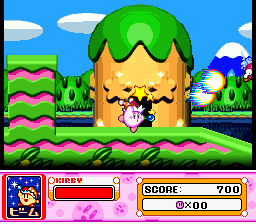
Most Kirby games are one adventure. Kirby Super Star — Hoshi no Kirby Super Deluxe (星のカービィ スーパーデラックス) in Japan — is a whole shelf of them: a beginner's remake of the first game, a treasure-hunting cave crawl with 60 hidden prizes, a timed assault on a flying battleship, a planet-hopping finale where you cannot copy abilities the normal way at all, a 19-round boss rush, and two reaction-based sub-games, all sharing one expanded move set. This guide treats it the way returning players actually use it: as a set of tables. Every mode, every Copy Ability and Helper, all 60 Great Cave Offensive treasures with values, every Milky Way Wishes Copy Essence Deluxe by planet, and the full Arena line-up are laid out below, with the SNES original kept strictly separate from the 2008 DS remake, Kirby Super Star Ultra.
Quick Facts
| Item | Detail |
|---|---|
| Japanese title | 星のカービィ スーパーデラックス (Hoshi no Kirby Super Deluxe) |
| Overseas titles | Kirby Super Star (North America); Kirby's Fun Pak (PAL regions) |
| Platform | Super Famicom / Super Nintendo Entertainment System (SNES) |
| Release date (Japan) | March 21, 1996 |
| Release date (North America) | September 20, 1996 |
| Release date (Europe) | January 23, 1997 |
| Developer | HAL Laboratory |
| Publisher | Nintendo |
| Director | Masahiro Sakurai |
| Music | Jun Ishikawa, Dan Miyakawa |
| Genre | Action / platformer anthology (omnibus format) |
| Players | 1–2 (simultaneous co-op via the Helper system) |
| Cartridge | 32 Mbit (4 MB), LoROM + SA-1 enhancement chip, battery-backed save |
| Japanese launch price | ¥7,500 |
| Tagline | "8 games in one!" (see the mode-count note in the Overview) |
| Remake | Kirby Super Star Ultra (Nintendo DS, 2008) — differences are listed separately in "How to Play It Today" and are not part of the SNES original |
Overview
Kirby Super Star is built as an omnibus: a corkboard menu offers several self-contained games that share the same core controls but play by different rules. Kirby keeps his series-defining inhale and float, and the Copy Ability system inherited from Kirby's Adventure is expanded in three ways that define this game. First, almost every ability now has a full move list — multiple attacks mapped to directions, dashes and button holds — which can be checked at any time on the pause screen, a first for the series. Second, each ability gives Kirby a distinct hat or costume, so the current ability can be read from his silhouette rather than the HUD. Third, pressing the A button converts the current ability into a Helper: a friendly version of the enemy that normally grants that ability, controlled by the CPU or by a second player on a second controller. Co-op side-scrolling of this kind was still unusual in 1996, and the Helper is the direct ancestor of later Kirby co-op systems.
Two quieter system changes matter just as much for strategy. This is the first Kirby game to replace the old "six hits and out" health points with a damage gauge, where different attacks deal different amounts of damage, and the first to give Kirby a guard (L or R) that nullifies most attacks outright. Ordinary enemies also have health of their own now, so a weak ability may need several hits where a strong one needs one. Food items — far more varied than the Maxim Tomato and Energy Drink of earlier games — restore health, and a Helper standing close when Kirby eats receives part of the effect (the "mouth-to-mouth" transfer that later games kept).
A note on counting the games. The box promises "8 games in one," Japanese references describe "seven action game modes and two sub-games," and Western references usually say "six primary games, one supplemental game, and two minigames." All three counts describe the same contents, sliced differently:
| Category | Contents | Count |
|---|---|---|
| Main games available from the start | Spring Breeze, Dyna Blade, Gourmet Race, The Great Cave Offensive | 4 |
| Main games unlocked by progress | Revenge of Meta Knight, Milky Way Wishes | 2 |
| Supplemental game (boss rush) | The Arena (Japanese name: 格闘王への道, "The Road to the Fighting King") | 1 |
| Sub-games (timing / reaction) | Megaton Punch, Samurai Kirby | 2 |
| Total playable entries on the corkboard | 9 |
The unlock chain is linear and worth memorising, because it decides the sensible play order:
Start:        Spring Breeze / Dyna Blade / Gourmet Race / Great Cave Offensive
                    |                    |
        clear Dyna Blade          clear Great Cave Offensive
                    |                    |
                    +--> Revenge of Meta Knight --+
                    |                             |
                    +-------> Milky Way Wishes <--+
                                  |
                            clear Milky Way Wishes
                                  |
                             The Arena (19 rounds)
                                  |
                        clear The Arena -> Sound Test
In practice, Great Cave Offensive and Revenge of Meta Knight are the two gates for Milky Way Wishes; Dyna Blade is the gate for Revenge of Meta Knight. Sub-games are available independently and never gate anything.
Why It Still Matters
Super Star is the Kirby game that later Kirby games keep quoting. The multi-move Copy Abilities, ability hats, the guard, the health gauge, Helpers, the boss-rush Arena format with a rest area and a limited stock of Maxim Tomatoes, and even the mouth-to-mouth food sharing all became series standards here or were proven here at scale. Director Masahiro Sakurai also carried the Arena's structure — consecutive boss fights broken by rest intervals with a few healing items — into the All-Star and Boss Battles modes of the Super Smash Bros. games he later directed. Within the series' own history it sits as the fourth action game (the seventh Japanese Kirby release overall), arriving in March 1996, only about three months before the Nintendo 64 launched in Japan — a late, large (32 Mbit, SA-1-assisted) Super Famicom production that still feels like a summary of everything the 16-bit Kirby team had learned.
It also remains the most re-readable Kirby of its era. Because the modes are short and rule-distinct, a returning player can pick exactly the flavour they want: a 20-minute beginner run, a score-attack race, a methodical treasure hunt, a timed story mode, or the Arena as a pure execution test. The strategy sections below are organised so that each of those returns starts from the right table.
Highlights
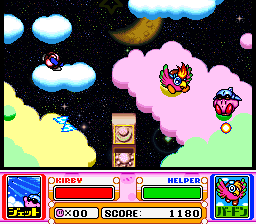
- The Helper system. Any standard ability can be sacrificed to summon its Helper, and a second player can pick up a controller and take over at any moment. Helpers can attack underwater, can hitch a ride on Kirby's feet while he floats, and — when their health runs out — enter a brief critical state in which touching an ability-bearing enemy revives them as that enemy's Helper at full health. Solo players get a competent CPU partner; two players get genuine co-op, which in 1996 was rare for the genre.
- The Great Cave Offensive's 60 treasures. A non-linear, four-area cave with save cottages, mine-cart links and four bosses — and a treasure list that doubles as a museum of mid-90s Nintendo references, from a Triforce and Mr. Saturn to Captain Falcon's helmet and a Mario & Wario bucket. Full list with values in Strategy Essentials.
- Revenge of Meta Knight's presentation. A timed, chapter-based assault on the battleship Halberd, with the enemy crew's increasingly panicked dialogue running along the bottom of the screen and occasionally doubling as hints. It is the most story-forward mode in the package and the template for later Kirby story modes.
- Milky Way Wishes' inverted rules. Inhaling enemies gives nothing (with five limited-use exceptions). Abilities are instead collected permanently as Copy Essence Deluxes hidden across seven planets and one hidden star — find one, and that ability is yours to select at any time, even mid-boss, for the rest of the mode.
- Two perfect sub-games. Megaton Punch (three chained timing inputs, scored from 2 Mt to a maximum of 201 Mt) and Samurai Kirby (a pure reaction duel against five opponents) are each playable in under a minute and endlessly re-challengeable.
Strategy Essentials
1. Mode Roster — Structure, Unlocks and Final Bosses
| Mode (EN) | Mode (JP) | Available | Structure | Final boss / goal |
|---|---|---|---|---|
| Spring Breeze | はるかぜとともに | From start | 4 stages; abridged remake of Kirby's Dream Land with Copy Abilities and Helpers added | King Dedede (Mt. Dedede) |
| Dyna Blade | 白き翼ダイナブレイド | From start | World map; 4 stages + boss stage, 2 hidden ability trial rooms, 1 roaming mid-boss | Dyna Blade |
| Gourmet Race | 激突!グルメレース | From start | 3 courses; Grand Prix vs. King Dedede or solo Time Attack | Highest score (Grand Prix) |
| The Great Cave Offensive | 洞窟大作戦 | From start | 4 connected areas, 60 treasures, save cottages, mine carts | Wham Bam Rock; escape to the surface |
| Revenge of Meta Knight | メタナイトの逆襲 | Clear Dyna Blade | 8 segments (see note) under per-stage time limits; battleship Halberd | Meta Knight, then a timed escape |
| Milky Way Wishes | 銀河にねがいを | Clear Great Cave Offensive + Revenge of Meta Knight | 7 planets + hidden star ??? + Nova; 19 Copy Essence Deluxes | Heart of Nova, then Marx |
| The Arena | 格闘王への道 | Clear Milky Way Wishes | 19 consecutive boss rounds, 1 life, no continues | Marx (always round 19) |
| Megaton Punch | かちわりメガトンパンチ | From start (sub-game) | 3 chained timing inputs vs. 3 CPU opponents, or 2P versus | Score 201 Mt (maximum) |
| Samurai Kirby | 刹那の見斬り | From start (sub-game) | Reaction duel; 3 difficulty levels × 5 opponents, or 2P versus | Meta Knight (5th opponent) |
Note on Revenge of Meta Knight's chapter count: Japanese references divide the mode into eight chapters, counting the final escape sequence (Chapter 8: escape the crashing Halberd within 50 seconds, riding Wheelie Rider) as its own chapter. Many English guides say "seven chapters" and treat the escape as part of the finale. The content is identical either way; the table in section 6 below follows the eight-part Japanese division.
2. Copy Abilities and Helpers — The Complete Working List
Counting Copy Abilities in Super Star is a known source of disagreement, so here is the breakdown this guide uses, and why totals elsewhere differ. There are 24 regular abilities. Of those, 19 have a Helper; the remaining 5 are limited-use abilities (one-shot or few-shot) and have no Helper. Two further forms exist only in specific situations and are counted separately: Starship, used for the shooting segment inside Galactic Nova in Milky Way Wishes, and Wheelie Rider, the form Kirby takes when riding a Wheelie Helper. Sources that say "25" are usually adding Starship; sources that say "26" add Wheelie Rider as well.
| Ability | Source enemy / mid-boss (typical) | Helper | Notes for strategy |
|---|---|---|---|
| Beam | Waddle Doo | Waddle Doo | First ability most players meet. Wave Beam (hold) reaches through walls; reliable everywhere. |
| Bomb | Poppy Bros. Jr. / Poppy Bros. Sr. | Poppy Bros. Jr. | Can be held and placed. Safe, ranged, and strong against grounded bosses. |
| Cutter | Sir Kibble | Sir Kibble | Boomerang cuts ropes and passes through walls on its return arc. Essential reach in caves. |
| Sword | Blade Knight | Blade Knight | Sword Beam at full health; fast, safe all-rounder. Forced choice at the Meta Knight duel (see section 6). |
| Fire | Burning Leo | Burning Leo | Fire Breath melts ice blocks; strong sustained damage at point blank. |
| Ice | Chilly / Mr. Frosty | Chilly | Freezes enemies into throwable blocks; melts nothing but stops almost anything. |
| Fighter | Knuckle Joe / Iron Mam | Knuckle Joe | The deepest move list in the game: grabs, rising uppercut, rapid jabs. High skill ceiling. |
| Hammer | Bonkers | Bonkers | Slow, huge damage; Hammer Flip is a boss-melter. Can pound stakes. One throw move discards the ability. |
| Stone | Rocky | Rocky | Invulnerable while transformed; the safest boss approach for beginners. Rare random transformations are cosmetic. |
| Parasol | Parasol Waddle Dee | Parasol Waddle Dee | Slows falls automatically; drills through some ceilings. Strong in vertical shafts. |
| Wing | Birdon | Birdon | Flight-based moves; fastest horizontal mobility of any standard ability. |
| Wheel | Wheelie | Wheelie | Transform and roll; Kirby can also ride a Wheelie Helper as Wheelie Rider. Very fast, poor braking. |
| Yo-Yo | Gim | Gim | Arcing throws hit above, below and through walls. A puzzle-solver as much as a weapon. |
| Plasma | Plasma Wisp | Plasma Wisp | Charge by wiggling the D-pad; a fully charged shield damages on contact. Arena favourite. |
| Jet | Capsule-J | Capsule-J | Charged jet dash crosses whole rooms; stores charge for later release. |
| Mirror | Simirror | Simirror | Reflects projectiles and splits Kirby's image; the defensive specialist. |
| Ninja | Bio Spark | Bio Spark | Wall-cling, kunai and vanish moves; rewards precise players. |
| Suplex | Bugzzy / Jukid | Bugzzy | Grab-and-throw wrestling; extremely high damage per grab on mid-bosses. |
| Copy | T.A.C. | T.A.C. | Analyses an enemy to copy its ability — in Milky Way Wishes this bypasses the essence system (see section 5). The T.A.C. Helper can steal abilities directly. |
| Cook | Chef Kawasaki | — (none) | Limited use: one activation cooks all on-screen enemies into food. No Helper. |
| Crash | Bomber | — (none) | Limited use: one screen-clearing blast. No Helper. Keep for crowded boss add-ons. |
| Mike | Walky | — (none) | Limited use: three escalating screen-wide song attacks. No Helper. |
| Paint | Paint blobs from Chameleo Arm / Heavy Lobster | — (none) | Limited use: one blast; uniquely effective against Heavy Lobster (blinds it). No Helper. |
| Sleep | Noddy | — (none) | Limited use in effect: Kirby falls asleep and recovers a little health. No Helper. Discard it unless you need the nap. |
Helper rules that decide fights:
| Rule | Detail |
|---|---|
| Summon | With a standard ability equipped, press A. Kirby loses the ability; the Helper appears. Kirby can immediately copy a new ability for himself, so the pair can cover two abilities at once. |
| 2P takeover | A second player pressing any button on controller 2 takes control of the Helper at any time. |
| Changing a Helper | If Kirby discards an ability (Select) while a Helper is active, the Helper transforms into the discarded ability's Helper. |
| Helper health | Helpers have their own health gauge and slightly lower defence than Kirby. If Kirby falls in solo play, the Helper disappears with him; in 2P play the run continues from the Helper. |
| Critical state | A depleted Helper does not vanish instantly: it slows and will disappear when its remaining time runs out, but touching an ability-bearing enemy first revives it as that enemy's Helper at full health. |
| Staying close | A Helper off-screen or in danger can hold A to turn into a star and fly back to Kirby. While Kirby hovers, a Helper can grab his feet (Up) to be carried. |
| Sharing food | If one partner picks up food and touches the other partner immediately, part of the recovery is shared. |
| Exceptions | Helpers cannot use moves that would return them to a "normal" state (for example, the Helper version of Hammer has no ability-discarding throw). All Helpers can attack underwater. |
Counting note on the Arena: the Arena's starting room offers 20 Copy Essences — the 24 regular abilities minus Cook, Crash, Mike and Paint. Sleep's essence is present, but Sleep cannot be turned into a Helper.
3. Spring Breeze and Dyna Blade — Stage and Boss Tables
Spring Breeze (tutorial in disguise; on a first playthrough its bosses have reduced health):
| Stage | Mid-boss | Boss | Notes |
|---|---|---|---|
| 1. Green Greens | Poppy Bros. Sr. | Whispy Woods | Inhale the falling apples if you have no ability. |
| 2. Float Islands | Mr. Frosty | Lololo & Lalala | Castle Lololo from the original game is folded into this stage. Beam or Yo-Yo hits through the blocks they push. |
| 3. Bubbly Clouds | Kracko Jr.; Bonkers (behind a hidden door) | Kracko | The Waddle Doos Kracko drops give Beam — the intended answer if you arrive empty-handed. |
| 4. Mt. Dedede | — | King Dedede | No boss rush before Dedede, unlike the Game Boy original. Stars from his landing can be inhaled and spat back. |
Dyna Blade (world map; cleared stages can be replayed freely):
| Stage | Notes |
|---|---|
| 1. Peanut Plains | Chef Kawasaki appears here for the first time in the series. |
| 2. Mallow Castle | Contains a hidden switch that opens Ability Trial Room 1. First forced-scrolling section in the game. |
| 3. Cocoa Cave | Hot and cold halves. Bugzzy (Suplex) debuts here. |
| 4. Candy Mountain | Ends in a mid-boss rush, including the game's first two-at-once mid-boss battle. Contains the hidden switch for Ability Trial Room 2. |
| 5. Dyna Blade's Nest | Boss only: Dyna Blade. Only its head takes damage; it has attacks that break guard. |
| Map event: Vs. Iron Mam | The mid-boss Iron Mam walks the world map; touching her starts the fight. She disappears from the map once beaten. |
The two Ability Trial Rooms hold a Maxim Tomato and Copy Essences for nearly every ability, with enemies to practise on. They are the safest place in the game to learn a move list before the Arena — and finding both is required for 100% completion.
4. Gourmet Race — Scoring Is the Strategy
Grand Prix is not a pure race. Winning a course is worth less than half of what careful eating on all three courses can add up to, so the correct mindset is "eat everything on the racing line, never detour twice."
| Scoring element | Points |
|---|---|
| Any food item eaten | 1 point |
| Maxim Tomato eaten | 3 points |
| Finishing a course first | 30 points |
| Courses in a Grand Prix | 3 (all three scores are totalled) |
| Course (EN) | Course (JP) | Character | Practical advice |
|---|---|---|---|
| 1. Pumpkin Grand | かぼちゃグランド | Mostly straight, with water, Star Blocks and small steps | Learn the scoring here: stay on the food line, use Copy Essences only if they cost no time. The famous Gourmet Race theme plays on this course (and course 3). |
| 2. Corn Hall | もろこしホール | Cave with heavy undulation; the route splits into upper and lower lanes in several places | Food is scattered on both lanes. Commit to one lane per split — crossing back costs more time than the food is worth. Flight control decides this course. |
| 3. Onion Garden | たまねぎガーデン | Long straights, vertical shafts, water, and a sky-palace layout; most complex of the three | Five Copy Essences stand at the start (left to right: Jet, Parasol, Ninja, Wing, Wheel). Wheel or Jet converts the long straights into free time; take one and go. |
In Time Attack, Dedede and the food disappear, times are recorded per course to 1/100 of a second, and beating a course in under one minute makes a ghost of your best run appear as a pace reference on later attempts.
5. The Great Cave Offensive — All 60 Treasures
The cave is four areas linked in sequence, with no goal until the final area: you can finish with zero treasures (the game acknowledges it with a special message), but 100% completion requires all 60. Save Cottages sit at the start of areas 2–4, boss ante-rooms offer Copy Essences and a Maxim Tomato, and many treasures are gated by ability properties — Cutter or Yo-Yo for ropes and switches at a distance, Hammer for stakes, Fire for ice and fuses, Stone or Fighter for stubborn blocks, and a Helper for the switches that must be held or hit simultaneously. When a treasure is missed, the pause-screen list shows the gap in collection order, which tells you roughly which area to re-search.
Area summary (counts cross-checked against the treasure numbering):
| Area (EN) | Area (JP) | Treasures | Numbers | Area total value | Boss |
|---|---|---|---|---|---|
| Sub-Tree Area | 地底の木々 | 13 | No. 1–13 | 1,067,690 G | Fatty Whale |
| Crystal Area | 水晶の畑 | 16 | No. 14–29 | 1,120,100 G | Computer Virus |
| Old Tower Area | 古代の塔 | 16 | No. 30–45 | 4,345,350 G | Chameleo Arm (can be bypassed) |
| Garden Area | 神秘の楽園 | 15 | No. 46–60 | 3,466,850 G | Wham Bam Rock |
| Total | 60 | 9,999,990 G |
The complete list, in the game's collection order. Values are in G (Gold). The set sums to exactly 9,999,990 G — a useful integrity check: if a guide's list does not total that figure, one of its values is wrong.
| No. | Treasure (EN) | Treasure (JP) | Value (G) | Area |
|---|---|---|---|---|
| 1 | Gold Medal | きんメダル | 10,000 | Sub-Tree |
| 2 | Gold Coin (Koban) | こばん | 1,000 | Sub-Tree |
| 3 | Whip (Indy Whip) | インディウィップ | 6,800 | Sub-Tree |
| 4 | Crystal Ball | クリスタルオーブ | 200,000 | Sub-Tree |
| 5 | Lucky Cat | まねきねこ | 500 | Sub-Tree |
| 6 | Seiryu Sword | せいりゅうとう | 142,000 | Sub-Tree |
| 7 | Screw Ball | スクリューボール | 80,000 | Sub-Tree |
| 8 | Echigo Candy | えちごやのおかし | 8,000 | Sub-Tree |
| 9 | Zebra Mask | しろくろマスク | 278,000 | Sub-Tree |
| 10 | Star Stone | ほしのしずく | 82,100 | Sub-Tree |
| 11 | Beast's Fang | まじゅうのきば | 7,300 | Sub-Tree |
| 12 | Bandanna | コマンドバンダナ | 1,990 | Sub-Tree |
| 13 | Springtime | はるのおもいで | 250,000 | Sub-Tree |
| 14 | Dime (10 Yen Coin) | じゅうえんだま | 10 | Crystal |
| 15 | Glass Slippers | ガラスのくつ | 120,000 | Crystal |
| 16 | Goblet | ゴブレット | 800 | Crystal |
| 17 | Saucepan | じょうぶなおなべ | 10 | Crystal |
| 18 | Brass Knuckle | ボンバーナックル | 20,000 | Crystal |
| 19 | Amber Rose | こはくのバラ | 22,100 | Crystal |
| 20 | Fish Fossil | さかなのかせき | 8,250 | Crystal |
| 21 | Beast Fossil | けもののかせき | 24,220 | Crystal |
| 22 | Nunchuks | リーのヌンチャク | 55,480 | Crystal |
| 23 | Bucket | バケツ | 200 | Crystal |
| 24 | Summertime | なつのおもいで | 250,000 | Crystal |
| 25 | 100 Dollar Coin (10,000 Yen Coin) | いちまんえんだま | 10,000 | Crystal |
| 26 | Ancient Gem | ほのおのまがたま | 68,000 | Crystal |
| 27 | Falcon Helmet | ファルコンメット | 41,000 | Crystal |
| 28 | Dud | ふはつだん | 30 | Crystal |
| 29 | Truth Mirror | しんじつのかがみ | 500,000 | Crystal |
| 30 | Star Tiara | スターティアラ | 408,200 | Old Tower |
| 31 | Turtle Shell | かめこうら | 800 | Old Tower |
| 32 | Sword (Falchion) | ファルシオン | 325,000 | Old Tower |
| 33 | Warrior Shield | せんしのたて | 50,000 | Old Tower |
| 34 | Unicorn's Horn | ユニコーンのつの | 80,300 | Old Tower |
| 35 | Autumntime | あきのおもいで | 250,000 | Old Tower |
| 36 | Rice Bowl | かけたおちゃわん | 50 | Old Tower |
| 37 | Tut's Mask | ツタンカーム | 160,000 | Old Tower |
| 38 | Mr. Saturn | どせいさんのぞう | 120,000 | Old Tower |
| 39 | Armor | ミスリルよろい | 212,000 | Old Tower |
| 40 | Treasure Box | せんりょうばこ | 100,000 | Old Tower |
| 41 | Mannequin | マネキン | 3,000 | Old Tower |
| 42 | Gold Crown | クイーンクラウン | 528,000 | Old Tower |
| 43 | King's Cape | はおうのマント | 508,000 | Old Tower |
| 44 | Model Ship | つきのうきふね | 800,000 | Old Tower |
| 45 | Sun Ring | たいようのゆびわ | 800,000 | Old Tower |
| 46 | Wintertime | ふゆのおもいで | 250,000 | Garden |
| 47 | Katana | めいとうサムライ | 990,000 | Garden |
| 48 | Charm | アミュレット | 8,000 | Garden |
| 49 | Xmas Tree | クリスマスツリー | 40,000 | Garden |
| 50 | Kong's Barrel | コングのたる | 1,500 | Garden |
| 51 | Ramia's Scale | ラミアのうろこ | 12,800 | Garden |
| 52 | Shiny Bamboo | たけとりのむすめ | 600,000 | Garden |
| 53 | Tire | カートのタイヤ | 1,100 | Garden |
| 54 | Spirit Charm | たましいのうでわ | 78,500 | Garden |
| 55 | Pegasus Wing | ペガサスのはね | 42,800 | Garden |
| 56 | Raccoon Doll | たぬきのおきもの | 8,150 | Garden |
| 57 | Shell Whistle | さざなみのふえ | 82,000 | Garden |
| 58 | Orihalcon | オリハルコン | 512,000 | Garden |
| 59 | Platinum Ring | プラチナリング | 40,000 | Garden |
| 60 | Triforce | トライフォース | 800,000 | Garden |
Reading the list strategically: the Old Tower holds the densest value (over 4.3 million G, including both 800,000 G pieces), the single most valuable treasure is the Katana at 990,000 G in the Garden, and the joke floor of the economy is the 10 G pair — the Dime and the Saucepan. Several names changed in the DS remake (for example Screw Ball becomes Screw Attack, the Sword treasure is named Falchion outright, and a handful of treasures such as Nunchuks and the four "season" memories were replaced or consolidated); the table above is the SNES original's list.
How to think about a full clear: clear each area's boss first so the mine-cart route onward is open, then sweep the area again with the widest ability coverage you can carry (Kirby's ability + a different Helper ability counts as two). Treasures behind one-way drops in the Garden should be collected on the way up, not left for a second pass. The Computer Virus boss in the Crystal Area is fought in RPG-style turns — you can only damage its monsters on your turn — and it is also the game's built-in damage meter, since damage numbers are displayed.
6. Revenge of Meta Knight — Chapters and Bosses
Every segment runs against a countdown; if it reaches zero, Kirby loses a life. The Halberd's damage meter at the bottom of the screen tracks overall progress. Crew dialogue at the bottom is not just flavour — it flags upcoming hazards and, in the Reactor fight, effectively explains the only way to win.
| Chapter | Route | Boss / set piece |
|---|---|---|
| 1 | Rear deck, by the rocket nozzles; boarding the Halberd before launch | Heavy Lobster — this first fight does not need to be won; the Halberd launches and blows Kirby away during it |
| 2 | Seashore, undersea cave, offshore island | Whispy Woods and Twin Woods |
| 3 | Forest and mountain, chasing the Halberd | No boss; Dyna Blade carries Kirby back to the ship |
| 4 | Deck, interior, before the main cannon | Combo Cannon (twin main cannon) |
| 5 | Deck, ship's side, left wing, ducts, right wing | Heavy Lobster (full fight). Its paint blobs give Paint — using Paint on Heavy Lobster blinds it, a trick the crew dialogue acknowledges |
| 6 | Ship's side and underside, central interior, Reactor | Reactor — Kirby's attacks cannot hurt it. Lure its reflected laser into the core three times |
| 7 | Rear interior, bridge, observation deck | The Meta-Knights, then Meta Knight. He waits until Kirby (or the Helper) picks up the sword planted in the deck — taking it forces Sword ability — or until a set time passes |
| 8 | Rear deck — escape | Timed escape: 50 seconds on Wheelie Rider, with Meta Knight in pursuit (he displays a health gauge here but cannot be damaged) |
7. Milky Way Wishes — Every Copy Essence Deluxe by Planet
The rule inversion, precisely: inhaling an enemy in this mode gives no ability — except the five limited-use abilities (Crash, Mike, Sleep, Cook and Paint), which can still be copied normally, and except via the Copy ability itself. Everything else comes from the 19 Copy Essence Deluxes below. Once collected, an essence is permanent for the rest of the mode and can be selected from the pause screen (or cycled with X) at any time, including during boss fights. You do not need all 19 to finish the story — seven planets' stars summon Nova — but 100% completion requires all 19, and the sensible route starts at the hidden star.
| Planet (EN) | Planet (JP) | Boss | Copy Essence Deluxes found here | Count |
|---|---|---|---|---|
| ??? (hidden star) | ??? | — | Copy | 1 |
| Floria | 草花の星 フロリア | Twin Woods | Ice, Fighter, Cutter | 3 |
| Aqualiss (Aquarius in the remake) | 水の星 アクアリス | Fatty Whale | Parasol, Sword, Beam | 3 |
| Skyhigh | 大空の星 スカイハイ | Kracko | Jet, Wheel, Wing | 3 |
| Hotbeat | 灼熱の星 ホットビート | Chameleo Arm | Fire, Suplex | 2 |
| Cavios (Cavius in the remake) | 洞穴の星 ケビオス | Wham Bam Rock | Bomb, Hammer, Stone | 3 |
| Mecheye (Mekkai in the remake) | 機械の星 メックアイ | Heavy Lobster | Yo-Yo, Plasma | 2 |
| Halfmoon | 常夜の星 ハーフムーン | Computer Virus (harder monster set: Magician, Evil Knight, Red Dragon) | Mirror, Ninja | 2 |
| Galactic Nova | ギャラクティック・ノヴァ | Heart of Nova, then Marx | — (Starship shooting segment; not an essence) | 0 |
| Total | 19 |
Route logic, in brief:
- Go to ??? first. The hidden star sits on the map between Skyhigh and Cavios (a small green star). Its three short rooms are full of T.A.C.s, and the Copy essence at the end restores the normal rules of the series: with Copy equipped, Kirby can analyse any enemy and take its ability, which collapses the early-game difficulty. Bombers in the second room also give Crash normally.
- Floria is a seasons puzzle. Doors cycle spring → summer → autumn → winter in the same long room. Ice is found by going left in winter; Fighter requires reaching the pool area door with the season set so the water is frozen or gone; Cutter is behind snow that only summer clears. Twin Woods can be challenged in autumn or winter.
- Hotbeat is a chain: Fire first (it is on the main route), then the mine-cart section hides Bugzzy — beat him to reveal Suplex.
- Planet names differ by version. The SNES original uses Aqualiss, Cavios and Mecheye; the DS remake renames them Aquarius, Cavius and Mekkai in English (the Japanese names are unchanged). Do not let a remake guide send you looking for a differently named planet — the layouts and essence locations correspond.
- Nova is two fights. The Starship segment is a forced-scrolling shooter; inside Nova, the Heart itself cannot be hit — destroy the eight pillars orbiting the room (each one destroyed speeds the rotation up; after five, the direction reverses). Marx follows immediately after, and he is the mode's — and effectively the game's — final boss: guard-piercing beam included, with Cutter and Ice copyable from his own projectiles even under this mode's rules.
8. The Arena (格闘王への道) — All 19 Rounds
Unlocked by clearing Milky Way Wishes. One life, no continues; the run is a single endurance test. Rounds 1–18 come in random order; round 19 is always Marx. Between rounds, the rest area offers two random Copy Essences and a stock of five Maxim Tomatoes that do not replenish across the whole run — the entire mode is resource management around those five heals. Clearing the Arena unlocks the Sound Test.
| Round slot | Opponent | First met in |
|---|---|---|
| Random | Whispy Woods | Spring Breeze |
| Random | Lololo & Lalala | Spring Breeze |
| Random | Kracko | Spring Breeze |
| Random | King Dedede | Spring Breeze |
| Random | Mid-Boss All Stars 1: Chef Kawasaki, Bonkers, Bugzzy | Various |
| Random | Dyna Blade | Dyna Blade |
| Random | Fatty Whale | Great Cave Offensive |
| Random | Mid-Boss All Stars 2: Poppy Bros. Sr., Mr. Frosty, Iron Mam, Jukid | Various |
| Random | Chameleo Arm | Great Cave Offensive |
| Random | Wham Bam Rock | Great Cave Offensive |
| Random | Twin Woods | Revenge of Meta Knight |
| Random | Combo Cannon | Revenge of Meta Knight |
| Random | Heavy Lobster | Revenge of Meta Knight |
| Random | Reactor | Revenge of Meta Knight |
| Random | Meta Knight | Revenge of Meta Knight |
| Random | Computer Virus (Milky Way Wishes monster set) | Great Cave Offensive / Milky Way Wishes |
| Random | Galactic Nova Nucleus (Heart of Nova) | Milky Way Wishes |
| Random | Waddle Dee (a single, extremely high-stamina Waddle Dee) | — |
| 19 (fixed) | Marx | Milky Way Wishes |
Practical Arena doctrine: pick a high-damage, low-commitment ability at the start (Hammer, Plasma and Fighter are the usual choices; Stone is the beginner-safe option), keep the same Helper family so your muscle memory carries across rounds, and spend Maxim Tomatoes on schedule rather than on panic — a heal saved past round 15 is usually worth more than one spent at round 5. The two All-Stars rounds are the quiet run-enders: three and four mid-bosses back-to-back with no rest area in between.
9. Sub-Games — The Numbers That Matter
| Megaton Punch | Samurai Kirby | |
|---|---|---|
| JP name | かちわりメガトンパンチ | 刹那の見斬り |
| Input | Three chained timings: power gauge, two alignment cursors, final timing bar | One button, on reaction |
| Score / measure | Power in megatons: minimum 2 Mt, maximum 201 Mt (a 201 cracks the planet through) | Reaction shown as a two-digit counter after the "!" signal; drawing early is a foul — two fouls lose the duel |
| CPU opponents | Waddle Dee → Knuckle Joe → Iron Mam | Waddle Doo → Wheelie → Chef Kawasaki → King Dedede → Meta Knight |
| Levels / modes | Vs. CPU or 2P versus | 3 difficulty levels (5 opponents each) or 2P versus |
| Lineage | Later remade as Gigaton Punch in Kirby & The Amazing Mirror | Successor to Kirby's Adventure's Quick Draw; later remade as Samurai Kirby in Kirby: Nightmare in Dream Land |
10. The 100% Checklist
| Requirement | Target |
|---|---|
| Clear all six main games | Spring Breeze, Dyna Blade, Gourmet Race, Great Cave Offensive, Revenge of Meta Knight, Milky Way Wishes |
| Dyna Blade secrets | Open both Ability Trial Rooms (switches in stages 2 and 4) |
| Great Cave Offensive treasures | 60 / 60 (9,999,990 G) |
| Milky Way Wishes essences | 19 / 19 Copy Essence Deluxes, including Copy on ??? |
| The Arena | Clear all 19 rounds (also unlocks the Sound Test) |
Who It's For
- Completionists who want a checklist with hard numbers: 60 treasures, 19 essences, 19 Arena rounds, and a save file that tracks all of it.
- Co-op players: this is still one of the best two-player Kirby experiences, because the Helper is a full character with its own move list, not a floating assistant.
- Players who found other Kirby games too easy: Spring Breeze will not change your mind, but Revenge of Meta Knight's timers, the back half of the cave, and the Arena will.
- Series historians: the origin point of ability hats, multi-move abilities, Helpers, the guard, the health gauge and the modern Arena format, in one cartridge.
How to Play It Today
| Route | What you get | Notes |
|---|---|---|
| Nintendo Switch Online — Super Famicom / SNES app | The SNES original | Added December 12, 2019. The most convenient legal route today; the Helper co-op works with two controllers. |
| Nintendo Classic Mini: Super Famicom / SNES Classic Edition | The SNES original, pre-installed | One of the 21 built-in titles on the 2017 mini consoles. |
| Kirby's Dream Collection (Wii, 2012) | The SNES original on disc | Anniversary collection; a good option if you already own a Wii. |
| Wii / Wii U Virtual Console | The SNES original | Released October 13, 2009 (Wii, Japan) and May 1, 2013 (Wii U, Japan). Note: both storefronts have since closed to new purchases, so this is a re-download route only. |
| Original cartridge | The SNES original | 32 Mbit SA-1 cartridge with battery save; check the save battery on any used copy. |
| Kirby Super Star Ultra (Nintendo DS, 2008) | Remake — not the original | See the separation table below before using any Ultra guide for the SNES game. |
Original vs. Ultra — what belongs to which version:
| Content | SNES original (1996) | DS remake Ultra (2008) |
|---|---|---|
| Main games | 6 + The Arena | Same 6 + The Arena, plus Revenge of the King, Meta Knightmare Ultra, Helper to Hero and The True Arena (final boss: Marx Soul) — all Ultra-only |
| Sub-games | Megaton Punch, Samurai Kirby | Those two, plus three new touch sub-games (Snack Tracks, Kirby Card Swipe, Kirby on the Draw) — Ultra-only |
| Jet Helper | Capsule-J | Replaced by Capsule J2 |
| Arena round | High-stamina Waddle Dee | Replaced by Bandana Waddle Dee |
| Milky Way planet names (EN) | Aqualiss, Cavios, Mecheye | Aquarius, Cavius, Mekkai |
| Great Cave treasures | 60, list in section 5 of this guide | Still 60, but several treasures were replaced or renamed (e.g. Screw Ball → Screw Attack; Nunchuks → Machine Parts; the four separate "season" memories largely consolidated/replaced) |
| Release | JP March 21, 1996 | JP November 6, 2008; NA September 22, 2008 |
Find the original Japanese cartridge
Disclosure: The Rakuten and Yahoo! Shopping links are standard shopping links. Enkeisha does not earn a commission from purchases made through these links.
Find original hardware editions on eBay
As an eBay Partner Network affiliate, Enkeisha may earn a commission from qualifying purchases made through these links.
Search eBay listings (affiliate link)
Check the language, region, hardware compatibility, condition and authenticity before buying. Search results may include reproductions; links do not endorse individual sellers.