Front Mission: Gun Hazard (Super Famicom) — The Side-Scrolling Wanzer Shooter Where Your Loadout Levels Up With You
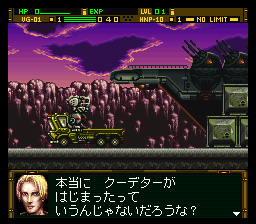
The first Front Mission (1995) is a turn-based tactical RPG played on a grid. One year later, its first spin-off threw the grid away. Front Mission: Gun Hazard puts you inside a wanzer in real time — running, dashing, hovering and shooting through side-scrolling battlefields across the whole planet — while quietly keeping the series' soul intact underneath: you still live or die by what you bought, what you equipped, and what you could afford. This article is therefore weighted toward strategy. In Gun Hazard, the carrier's setup screen is not a pause between the action; it is where the action is won.
Do not confuse the two games: Front Mission (Super Famicom, 1995, by G-Craft) is a simulation / tactical RPG. Front Mission: Gun Hazard — full Japanese title Front Mission Series: Gun Hazard — is a completely separate work: a side-scrolling action RPG by a different developer, Omiya Soft, set in an alternate universe with its own story. Advice for the tactical game's part-based damage, weight limits and turn order does not apply here, and vice versa. This article covers the original Super Famicom version of Gun Hazard only.
Quick Facts
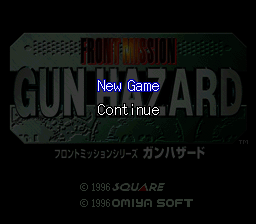
| Item | Detail |
|---|---|
| Original title | フロントミッションシリーズ ガンハザード (Front Mission Series: Gun Hazard) |
| English title | Front Mission: Gun Hazard (no official English release; Japan-only) |
| Platform | Super Famicom (SFC) |
| Release date | February 23, 1996 (Japan only) |
| Developer | Omiya Soft |
| Publisher | Square (Squaresoft) |
| Genre | Side-scrolling action RPG (shooter with RPG progression) |
| Director | Hideo Suzuki |
| Character design / artist | Yoshitaka Amano |
| Music | Nobuo Uematsu, Yasunori Mitsuda, with Junya Nakano and Masashi Hamauzu |
| Cartridge | 24 Mbit (3 MB), HiROM / FastROM, ROM + RAM + battery (battery-backed save) of this article |
| Setting | 2064, an alternate Front Mission universe; the unfinished orbital elevator "Atlas" and a worldwide chain of coups |
| Later official re-release | Japanese Wii Virtual Console, May 20, 2008 (service ended January 31, 2019) |
Overview
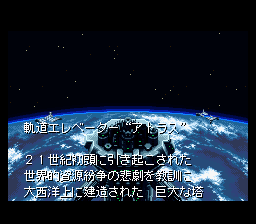
In 2024, with natural resources dwindling, the nations of the world began building an orbital elevator, "Atlas," to harvest space-based energy. Before it could be finished, miniature fusion reactors made it obsolete; Atlas was left incomplete, and the world slid back into conflict. Forty years later, in January 2064, a coup d'état erupts in Bergen, Norway: Ark Hellbrand of the Bergen Army moves to overthrow President Orwen. You are Albert Grabner, a wanzer pilot assigned to protect the president. The escort fails, Albert is captured, and he escapes from prison with the help of Brenda Lockheart, a mercenary of the Kernelight Association. Working for that mercenary guild takes Albert to war zones all over the world — and gradually exposes a link between the local conflicts, the Bergen coup, and an organisation known only as "The Society."
Structurally, the game alternates between three layers. Story events advance on a point-and-click world map. Missions themselves are real-time side-scrolling stages: you pilot Albert's wanzer left and right across 2D battlefields, shooting with a primary weapon and a set of secondary weapons, while an on-screen enemy meter shows how many hostiles remain to be spawned into the stage — fight until it empties and the stage falls quiet except for fixed defences. Between missions, aboard your carrier, you spend your earnings on new wanzer bodies, weapons and equipment, choose a support partner, and sortie again. Mission rewards combine a payment for the objective with money and experience tied to your kill count, so how you clear a stage matters, not just whether you clear it.
Two systems make this more than a run-and-gun. First, Albert can eject and proceed on foot at any time: small, fragile, armed with a pistol and grenades, but equipped with a jetpack of unlimited fuel and able to slip through passages no wanzer can enter. Second, progression is usage-based as well as level-based — the subject of the strategy section below, because it changes how you should buy almost everything.
Why It Still Matters
Gun Hazard is the series' great detour: the first spin-off and the second Front Mission release overall, and still the only entry built as a side-scrolling action game rather than a tactics game. It was developed by Omiya Soft, which included staff with roots in Masaya, the maker of Assault Suits Valken (Cybernator overseas) — and it shows in the weight and momentum of the wanzer's movement. Where the numbered entries ask how you position a squad, Gun Hazard asks how a single machine feels to pilot when every upgrade is bolted onto it.
It also matters as a document of mid-1990s Square at full stretch: an original, globe-spanning war story in an alternate timeline, character design by Yoshitaka Amano, and a mechanical, industrial score led by Nobuo Uematsu and Yasunori Mitsuda — their second collaboration after Chrono Trigger — with additional tracks by Junya Nakano and Masashi Hamauzu. Reported Japanese sales of roughly 300,000 copies made it a solid domestic success.
And yet, officially, it never left Japan. The Super Famicom cartridge received no North American or European release; its only later official edition was the Japanese Wii Virtual Console version (2008–2019). English-speaking players who know it at all usually know it through the unofficial fan translation released by Aeon Genesis in 2004. That obscurity is precisely why a strategy-first article is useful: the game's systems are deep, its menus assume you will experiment, and for years there was very little English-language guidance to experiment with.
Highlights
- A wanzer that grows the way you use it. Weapons and bodies have a proficiency percentage that rises as they take and deal punishment in missions, raising damage, magazine size and HP with use. Your favourite gun literally gets better because it is your favourite gun.
- Two games of scale in one stage. In the wanzer you are the heaviest thing on the field; on foot you are one grenade's splash away from death, but you can fly indefinitely and reach places the machine cannot. Stages are designed around switching between the two.
- A partner system with real teeth — in both directions. One support ally accompanies you per mission: off-screen fire support, an on-screen second wanzer, a mine-layer, a shield-bearer. The right partner is sometimes mandatory to progress at all; the wrong one wanders into fire and eats your repair items.
- A genuinely global campaign. Norway, Europe, the Middle East, Africa, Asia, the Americas: each area is a cluster of missions on the world map with its own shop stock, and the freshest equipment is not always in the area you are fighting in.
Strategy Essentials
This is the core of the article, in three parts: how to build the wanzer, how the campaign is structured and where its choices bite, and how to run the money.
1. Wanzer construction and weapons
The three growth systems (learn these first)
Everything you equip is governed by three interacting systems. Most failed runs trace back to ignoring one of them.
| System | How it works | Practical consequence |
|---|---|---|
| Pilot level | Albert (and each ally) gains experience from missions; levelling raises HP and, crucially, unlocks equipment tiers | Almost every weapon and piece of equipment, the wanzer bodies included, comes in five levels/grades — and you cannot buy a grade until Albert has reached the level it requires. Gear is gated by the pilot, not just by cash |
| Proficiency (usage) | Each wanzer body and each weapon starts at 0% and gains proficiency as it is used in missions; body proficiency raises its HP, weapon proficiency raises damage and magazine size | A brand-new, higher-tier body can briefly feel weaker than the worn-in one it replaces, because the new frame starts at 0%. Change bodies between missions, then give the new frame a forgiving stage to break in — never debut an untested build in a boss stage |
| Slots | The starting wanzer has 1 secondary-weapon slot; later bodies raise this step by step to a maximum of 6 | Your build's breadth is a function of your body. Early on you must choose one answer; by the endgame you carry a toolkit. This is why the body is the game's central purchase (see §3) |
Basic actions
| Action | Input / requirement | Notes |
|---|---|---|
| Move / aim | D-pad; Up and Down angle the gun | Hold L to lock the gun's angle while moving |
| Dash | Double-tap Left or Right — requires a Dash Unit | No usage limit, so it is also your travel speed. You keep facing the way you dashed until it ends, and ramming an enemy or a wall bounces you back with damage — dash through open ground, not into crowds |
| Jump / Vernier (hover) | B to jump; hold B with a Vernier Unit fitted to hover | Hover time and altitude grow with the Vernier grade. Releasing hover is sluggish; start your descent before you need it, especially over pits and under ceiling fire |
| Primary weapon | Y | Fixed for the mission — it cannot be changed mid-stage, only aboard the carrier. Choose it for the stage, not in the abstract |
| Secondary weapons | X cycles the equipped secondaries, A fires the selected one | Secondary ammunition does not regenerate mid-stage; it is refilled between missions or by a Bullet item |
| Shield | R (on the ground, with a Shield Unit) | Blocks frontal fire while deployed. Higher shield units widen coverage from the upper body to the whole body |
| Eject / board | Select | On foot: pistol and grenades, unlimited-fuel jetpack, tiny target, very low durability. Scout, fetch and traverse on foot; fight in the wanzer |
| Menu / items / ally orders | Start | Items (repair kits, ammo refills) and ally commands live here; the menu also shows a minimap with enemies and items |
Primary weapons: four families
| Family | Behaviour | Strengths | Costs and cautions |
|---|---|---|---|
| VG — Vulcan Gun | Rapid-fire machine gun; the weapon you start with. Continuously trickle-reloads | Large magazine, forgiving to aim, steady chip damage at any range | Individually weak per shot, and the trickle reload is slow enough to leave you dry in a thick fight. Pair it with a close-range secondary (HNP) for the reload gaps |
| SG — Shotgun | Fires a shell that splits into multiple pellets. Fast, full-magazine reloads | Devastating up close; even at long range roughly half the spread typically connects, so it degrades gracefully. The most forgiving all-rounder, and the primary most guides settle on | You must still close distance to get full value; against ceiling and air targets the spread thins out |
| LG — Laser Gun | A large, continuous beam | Strong, constant pressure at range; no travel time | Burns ammunition extremely fast and spends much of its life reloading. Powerful on paper, punishing in practice; buy it for a specific stage, not as a default |
| NG — Napalm Gun | Heavy explosive rounds on a shallow arc; continuously reloads | The highest damage of the primary families | Cannot be bought. NG models are found in stages, with no shop upgrades sold. If you find one, it can carry you until a shop family two grades up catches it — but plan your spending as if it did not exist |
Buy within one family and stay there: proficiency is per-weapon, so hopping families resets your damage and magazine growth each time. For a first playthrough, the SG line is the low-regret path — VG-01 $1,000 → VG-05 $56,000 and SG-01 $3,000 → SG-05 $68,000 in catalogue prices (see the pricing note in §3) — while the LG line runs dearer for its performance (LG-01 $4,000 → LG-05 $100,000).
Secondary weapons: build a toolkit, not a pile
Secondaries are where builds differentiate. The catalogue is large; these are the load-bearing choices.
| Secondary | What it does | Verdict |
|---|---|---|
| REP — Repair | Launches a repair orb that restores your wanzer's HP (an ally standing in it is healed too) | Non-negotiable. One slot is permanently REP's, on every body, at every stage of the game |
| EAP — Enhanced Armor Protection | A passive module that increases HP | The quiet second slot. Unflashy, always on, and it compounds with body proficiency |
| HNP — Hand Punch | A melee strike with knockback that penetrates shields | The best early secondary: powerful, trains quickly, and covers your primary's reload. Ground-only and it exposes you — learn its range |
| BZS — Bazooka | A single very powerful missile, low ammunition | Your boss button. Low capacity is exactly why it belongs in a slot rather than as your plan A |
| HMS — Homing Missile | Fires a missile that homes on enemies | Convenient against movers, but tracking is unreliable against fast targets and damage is modest. A comfort pick, not a core pick |
| FBG — Fireball / flamethrower | Short-range continuous flame | Enormous damage in a very short time at point-blank range — a boss-melter if you can survive the approach |
| UVG — Upward Vulcan | Fires straight up | Solves ceiling turrets and overhead bosses that no primary angles well against. Niche, but the niche is real |
| BNC — Bouncing Shot | A ball that ricochets off walls, floors and ceilings | Strong in enclosed stages, with generous ammunition; it keeps working until it hits something |
| DCY — Decoy | A hovering beacon that draws enemy fire | A late-game luxury for the 5th–6th slot, when your core is complete and survival, not damage, is the constraint |
| MIN / SEK — Mines and sled mines | Dropped / ground-skimming explosives | Enemies in this game hold position more than they patrol; static explosives underperform. Skip until slots are free |
Some secondary weapons are field pickups, including the SPS, a very powerful lightning weapon. Treat finds as windfalls, never as budget lines.
Mobility and defence units
| Unit line | Range (catalogue) | What improves | Advice |
|---|---|---|---|
| Dash Unit (RD) | RD100 $2,000 → RD400 $100,000 | Dash length and speed (the four models trade one against the other until the top model gives both) | Buy the first Dash Unit as soon as it is offered — dashing is movement, evasion and travel in one. Then skip grades; the top model is an endgame purchase |
| Vernier Unit (VU) | VU-01 $1,000 → VU-05 $64,000 | Hover time, thrust and altitude | Hover is mandatory kit, not an accessory: stage traversal and several fights assume it. Upgrade when a stage's vertical demands expose your current ceiling |
| Shield Unit (SHD) | SHD-01 $1,000 → SHD-04 $100,000 | Coverage widens from upper body to whole body | Worth one early purchase; after that, positioning and the shield-bearing ally (see §2) do more work than shield grades do |
   The build, in one diagram — what each layer is FOR:

   BODY ......... slots, defence, HP ceiling, proficiency growth
   PRIMARY ...... the one decision you cannot change mid-stage
   SECONDARY .... REP (always) + EAP + one answer per problem
                  the stage actually presents
   MOBILITY ..... Dash = ground truth, Vernier = air truth
   PILOT ........ eject for what the wanzer cannot reach;
                  never duel a wanzer on foot
2. Stage structure and branching
Gun Hazard is linear in its story but not in its map. Progression runs on a world map of regional mission clusters, broadly in the manner of Super Mario World: paths branch between nodes, new areas open as the story advances, and cleared missions can be replayed — which is a structural feature, not a convenience, because replaying is how the economy in §3 is meant to be serviced. Within a stage, the flow is always the same contract: work through the side-scrolling field, drain the enemy meter (spawning hostiles arrive one or two at a time until it empties), handle the fixed defences and the boss or objective, and extract. Two kinds of choice matter: which node next, when the map offers more than one, and who comes with you — because some stages silently require a specific partner.
| Phase | Region / focus | What changes for the player |
|---|---|---|
| 1. The coup | Bergen, Norway — the escort, the fall, the prison break | Scripted opening. You learn the wanzer, then lose everything and meet Brenda; the Kernelight Association becomes your employer and your carrier |
| 2. First contracts | Europe and the early world tour; HQ contact in New York | The real game opens: first free shopping, first partner choices, first replayable nodes. Spend this phase settling on one primary family (see §1) |
| 3. Widening war | Middle East, Africa, Northwest and Northeastern Asia | Shop stock diversifies by region — the most current gear is typically stocked in North America, so route shopping deliberately rather than buying where you happen to stand. Two famous gates live in this band (below) |
| 4. The heavy tour | North America, Western and Eastern South America | Top-tier bodies and weapons appear; the X-D's six slots come into reach. A new carrier must be collected in Western South America before the endgame can begin |
| 5. Endgame | The Society's flying fortress | Bring a finished build and a levelled partner. There is no economy left to fix mistakes with — only the loadout you arrive with |
The two partner gates (the campaign's real branches). Most nodes can be attempted in a flexible order, but progression twice depends on your partner selection rather than your firepower:
- The Northeastern Asia tunnel. A long tunnel stage cannot be cleared by shooting: you need the mine-laying partner (the man in sunglasses) in your active slot, so his mines open the way — and you must keep this often-underlevelled ally alive to the end of the stage. Bring REP items for him, not for yourself.
- The super-laser boss in Northeastern Asia. The counter is the shield partner, who is not on your roster yet: he must first be found in a stage in the upper-right of the Middle East map, where a shield-type wanzer is waiting. With him active, toggle his shield through the command menu only while the laser fires — his shield energy is finite, and leaving it up wastes the one resource the fight is balanced around.
Read both gates as the game's thesis in miniature: when a stage resists force, the answer is in the Friend page of the setup screen, not in a bigger gun. If you are stuck anywhere, check your partner before you check your wallet.
   World-map logic, simplified:

   BERGEN ──► early contracts ──► regional clusters (order partly free,
      │                            missions replayable)
      │                               │
      │                    partner gates: mines (tunnel),
      │                    shield (laser boss) — recruit first,
      │                    in the Middle East, if blocked
      ▼                               │
   new carrier (W. South America) ◄───┘
      │
      ▼
   flying fortress (endgame — no more shopping fixes)
3. Money: income, prices and priorities
Income has exactly three sources: the mission completion reward, the per-kill earnings folded into your mission results (which is why draining the enemy meter fully before extracting pays better than rushing the exit), and replaying cleared missions. There is no arena and no sale of found super-weapons you would be foolish to part with — the economy is a mercenary's: get paid per job, spend per deployment.
A note on prices. The dollar figures in this article follow the long-circulated English-language catalogue of the game's shops (Weggy's FAQ, 2004), cross-checked for tier structure against contemporary reviews; individual shop displays in-game are the final authority, and one regional variation is widely reported by that same catalogue — the Middle East shop sells at a 10% discount — so verify large purchases there in-game before committing.
| Wanzer body | Catalogue price | Secondary slots | Defence | Role in your progression |
|---|---|---|---|---|
| FN-8G | $5,000 (starting body) | 1 | 0 | Small, open-cockpit starter. Its single slot is REP's by definition |
| SW-46S | $12,000 | 2 | 4 | The first real build: REP + one answer. You will live in this frame a long time — its proficiency is an asset, not a stopgap |
| SW-54S | $40,000 | 3 | 8 | The mid-game workhorse; a large HP step and a third slot for EAP or a boss weapon |
| SW-82K | $100,000 | 4 | 11 | A modest step over the 54S for a steep price. Buy it when a fourth slot solves a specific problem, not from momentum |
| X-D | $300,000 | 6 | 21 | The endgame frame: the full toolkit at once, and HP that grows very fast with proficiency. Worth targeted saving — and worth levelling Albert to unlock |
Spending priority, in order:
- Bodies before guns. A body raises slots, defence and your HP ceiling simultaneously, and every later purchase assumes the slots it provides. A top-grade weapon on the FN-8G is a $50,000 answer in a one-slot frame.
- REP, always current. Your repair secondary is the only purchase that converts directly into finished missions. Keep it within one grade of your body.
- One primary family, upgraded on schedule. Prices roughly double per grade across every catalogue (body line: $5,000 → $12,000 → $40,000 → $100,000 → $300,000). Skipping a grade you do not need is the single largest saving available; proficiency rewards the family you stayed with.
- Mobility early, cheaply. The first Dash Unit and a serviceable Vernier change how every stage plays for a few thousand dollars. Their top grades are endgame luxuries.
- Your partner's frame is a real expense — budget for one. Allies gain levels and need their own wanzers upgraded to stay survivable; funding Albert alone produces a partner who dies in the tunnel (§2) at the worst possible moment. Concentrate on the one or two partners you actually deploy.
- Human gear last. Albert's on-foot pistol is mostly a box-opener; his grenades and aviation suit matter for the on-foot sections, but they are the cheapest lines in the catalogue and the last place money is tight.
- Shop like a mercenary. When a big purchase looms (a body, a grade-5 weapon), check the freshest stock (typically North America) for availability and the discount shop (the Middle East, per the catalogue note above) for price — and replay two or three comfortable cleared missions rather than one miserable new one to close the gap. Replays also pay in proficiency, which no shop sells.
Who It's For
- Action-RPG players who want a run-and-gun with a real preparation layer — builds, partners and budgets — rather than reflexes alone.
- Front Mission fans curious about the one entry that plays nothing like the others, and who can accept an alternate-universe story that stands alone.
- Assault Suits Valken / Cybernator and Metal Warriors players: the staff lineage and the heavy, momentum-driven mech handling will feel like coming home.
- Import-comfortable players. The cartridge is Japanese-only; menus carry a good deal of English and are structurally readable, but the story — a large part of the game's value — is Japanese text throughout.
How to Play It Today
- Original Super Famicom cartridge: The authentic route covered by this article. Japan-only release, Japanese text; second-hand copies circulate through Japanese retro retailers and marketplaces.
- Wii Virtual Console (historical): The game's only official re-release, sold on the Japanese Wii Shop Channel from May 20, 2008 until the service closed on January 31, 2019. It can no longer be purchased; existing downloads were not transferable to later hardware. There is, as of November 2026, no current official download edition — a fact worth knowing before paying a premium for any listing that claims otherwise.
- Unofficial English fan translation: Aeon Genesis released a complete English translation patch in 2004. It exists and is how much of the English-speaking audience knows the game, but it is a fan work, not an official edition, and this article's facts describe the Japanese original.
- Whichever route you choose, pace the first session: the opening hour runs coup, capture and escape in sequence, and the build systems only fully open once the Kernelight contracts begin.
Find the original Japanese cartridge
Disclosure: The Rakuten and Yahoo! Shopping links are standard shopping links. Enkeisha does not earn a commission from purchases made through these links.
Find original hardware editions on eBay
As an eBay Partner Network affiliate, Enkeisha may earn a commission from qualifying purchases made through these links.
Search eBay listings (affiliate link)
Check the language, region, hardware compatibility, condition and authenticity before buying. Search results may include reproductions; links do not endorse individual sellers.