One man has lost his left arm. The other is blind and has difficulty walking. They are about to fight with real swords. Before Shigurui lets you admire their strength, it shows you bodies that have already paid for it.
The setting is a tournament before the lord of Sunpu Castle in 1629. Gennosuke Fujiki faces Seigen Irako. Before their fight can end, the story goes back seven years, to a sword school in Kakegawa. How did two young men who trained under the same roof become these opponents? The answer accumulates in every muscle, every finger around a hilt.
Takayuki Yamaguchi expands Norio Nanjo’s story Mumyo Sakanagare, from Suruga-jo Gozen Jiai, into fifteen Japanese volumes. The sword fights are extraordinary. What makes the whole manga harder to leave behind is the question underneath them: what can these men actually choose? Being able to cut down another person brings them surprisingly little power over their own lives.
For adult readers: the manga contains graphic bodily injury, sexual violence and coercion, and suicide. Discussion of later relationships and the ending is kept inside the collapsed section below.
01
You learn to fear the distance
Watch what happens before a blade lands. How far does the sword draw back? Where does the foot settle? What does one man notice before the other moves? Yamaguchi shifts from fingers to feet to a wider view of the space between two bodies. You begin reading for the action that has almost happened.
When the young Irako challenges Gonzaemon Ushimata, the enormous wooden sword and Ushimata’s back dominate the foreground. Irako stands much smaller beyond them. The composition does more than announce a difference in size. It makes the distance Irako thinks he controls feel uncertain. Getting close is frightening before anyone demonstrates how fast they can strike.
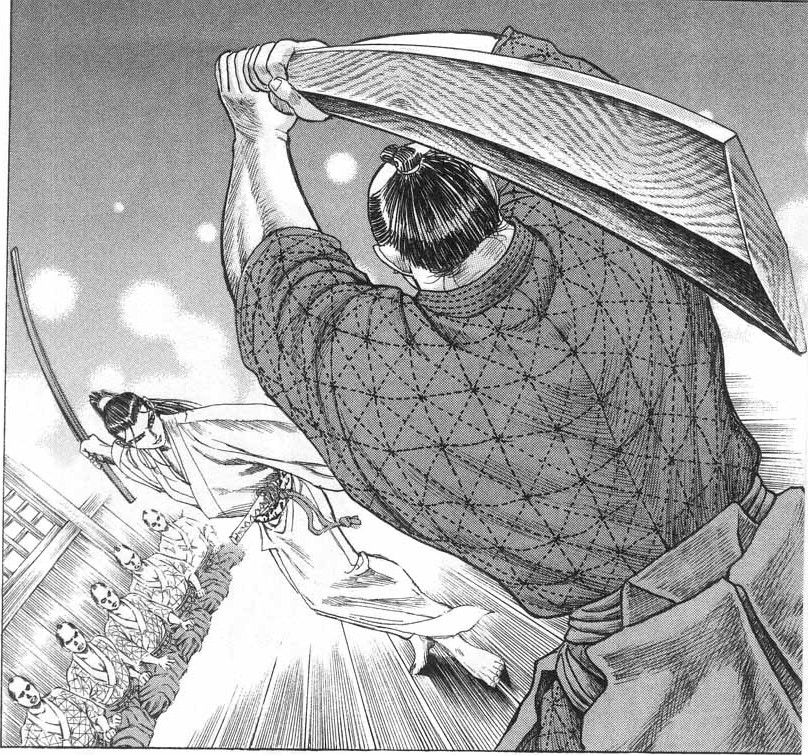
The school’s techniques depend on the grip as well as the blade. An attack that seems to extend the sword has a physical trick behind it. A named move sends your attention back to the posture and practice that make it possible. Even at its most outrageous, the fighting has a texture you feel you could touch.
That precision makes the injuries harder to bear. The beauty of a trained body and the fragility of a damaged one occupy the same page. Images of exposed musculature, beasts, and demons also convey perception and obsession; they do not always describe literal transformations. A technical explanation can become a picture of what facing this person feels like.
02
Fujiki’s silence is full of feeling
Fujiki can be difficult to read. He bows to his teacher, Kogan Iwamoto, follows orders, and keeps training. Beside Irako’s charisma, he sometimes seems as immovable as a stone. Yamaguchi makes us look for feeling in small disruptions to that stillness.
During solitary practice, an agonizingly slow swing consumes his strength. The time required to produce a fast strike is invisible in the strike itself. The manga lets us sit with that time: the work done when there is nobody there to applaud.
In volume five, ordered to perform a potentially lethal training form, Fujiki requests a drink and briefly sleeps while sitting upright. The small figure enclosed by the room’s pillars and floor looks painfully ordinary. He prepares his body for the next task rather than naming his fear. Such preparation has become part of everyday life.
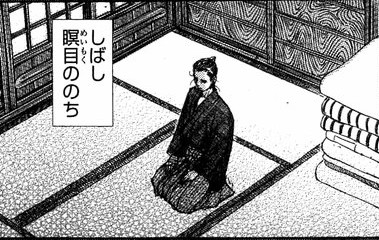
Yet reducing him to an obedient puppet loses the reason to follow him. There are glances toward fellow pupils, unexpected smiles, tears that break his composure. With Kogan’s daughter Mie, a man who knows how to move with a sword is slow to understand how to touch another person or tell her something she needs to hear. Eventually, a change in his face can feel as momentous as a fight.
03
Irako wants to be seen—and to rise
Irako understands the power of being watched. From his arrival at the dojo, he studies what other men prize and what they resent, looking for a way through. Talent, beauty, and the hunger to improve his position are inseparable in him.
A teacher’s approval could bring inheritance of the school and marriage to Mie. Swordsmanship suddenly has a measurable social future. It is easy to want this gifted young man to escape the narrow place allotted to him. His rebellion has real appeal.
Anger born of humiliation does not make everything he does just. Irako can recognize another person’s suffering and inflict suffering himself. Moments of tenderness are followed by cruelty that makes the sympathy you have offered uncomfortable. The manga will not let him become a reassuring liberator.
Nor does the rivalry fit neatly into hard work against genius, or loyalty against betrayal. Both men punish their bodies. Both stake their lives on recognition. They differ in what they experience as a debt, whom they bow to, and how much of themselves they will surrender. Their conflict grows out of that difference, even as each becomes uniquely equipped to understand the other.
04
The lives beyond the sword
For Kogan, choosing an heir and choosing his daughter’s husband are the same problem. Mie’s wishes matter less than the strength of the children she might bear. The authority of teacher and father converges in a household that treats her body as part of the school’s future.
Iku, Kogan’s concubine, is another woman who cannot simply leave. Describing her attachment to the young Irako as a seduction that makes men fight erases what she needs to escape. She and Mie occupy different positions, but both know what it means to be treated as someone’s possession.
The way the manga displays women’s nakedness and pain can still be troubling. Its criticism of domination does not settle every question about the images it asks us to look at. I felt for these women while sometimes finding the presentation of their suffering exhausting.
What holds my attention is the life that continues when the men’s reputations collapse: finding food, cleaning a damaged body, working out how to live tomorrow. In the later volumes, what Mie wants can no longer be contained by the restoration of a family name. She wants a life with a person. That desire gives the reader another way to measure the importance of a duel.
05
The beautiful room is a trap
An orderly garden. A polished corridor. Pupils sitting in impeccable rows. Shigurui is frightening partly because its spaces are beautiful. Danger is already built into the ceremonies and commands, long before an intruder disturbs the arrangement.
The dojo’s rules speak of respect for an opponent. Its members must nevertheless decide what someone’s body is worth when their own prestige is wounded. Even an initiation joins the terror of a blade to the applause that follows. By the time belonging feels good, the violence of the place has become part of that belonging.
For readers unfamiliar with the setting, this dojo is much more than a modern sports club. In this story, the teacher’s authority extends to housing, income, family identity, and marriage. Stipends expressed in koku concern livelihood and social position, rather than functioning as scores for combat ability. A loss of standing can dismantle a household.
This remains historical fiction. The manga’s anecdotes and cruelties should not be treated as automatic proof of what happened in the Edo period, or as universal truths about Japanese people. The compelling problem is specific and intimate: respect, gratitude, love, and terror can all attach to the same person.
Readers looking for a succession of satisfying victories may find these fifteen volumes punishing. But the experience of seeing an impossible stance, then gradually discovering the life that made it necessary, is remarkable. Once you know what the last strike can and cannot resolve, the two damaged bodies at the beginning demand another look.
THE ENDING
What remains after victory?
Open discussion of volumes 7–15, the final duel, and the ending (major spoilers)
They once watched the same sea
Volume seven shows an earlier swimming exercise in which Irako saves Fujiki from drowning. There is no elaborate game between enemies afterward. Fujiki apologizes for his failure and thanks him. Ushimata is delighted to see the two together. Once we have seen this, their later hostility can no longer seem inevitable.
That night the pupils watch a sea turtle laying eggs. A wide stretch of beach holds the pupils looking in the same direction. For a moment the composition seems to suspend the dojo’s hierarchy. Irako experiences belonging to a group. There was a time when he could have loved this place.
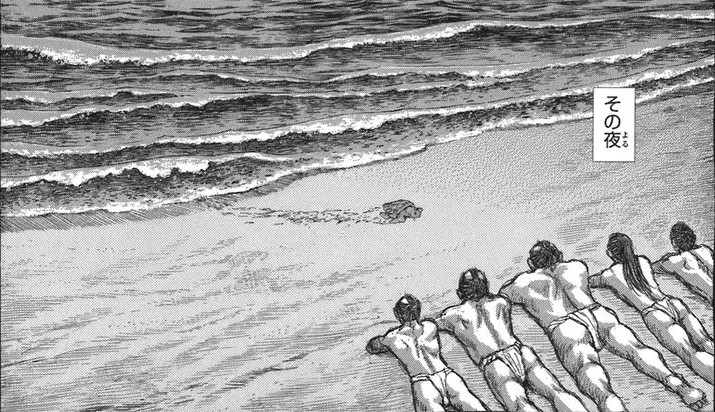
The understanding that returns near the end has roots in that lost possibility. Fujiki eventually realizes that Irako’s apparently idle moments in the dojo were also preparation for a real fight. Revising his judgment of the other man requires him to reconsider the life he himself has lived.
Wanting to see a rainbow does not absolve him
In volume fourteen, Irako brings medicine for the sick Fujiki. He is hurt by Mie calling him an enemy to be avenged, and speaks of wanting to see a rainbow again. Someone we could reduce to an agent of revenge suddenly becomes a man who misses a particular kind of beauty.
In the same volume, he helps a poor girl, then murders two servants who have insulted her. Understanding the pain of those beneath you does not determine how you will use power. The man who associates rising in rank with freedom also acquires the violence of the people he hates.
His words across divisions of rank to a poor blind man in the final volume moved me. They cannot cancel the lives he has taken. Irako holds our attention because beauty, anger, compassion, and ugliness remain in the same body to the end.
A promise under falling blossoms
After Fujiki and Mie lose their home, a sword’s reputation cannot put food in a bowl. Mie walks in search of provisions; Fujiki waits for her. A smile disguises an empty basket, while porridge has been prepared. Shared attention to the other person’s hardship brings them closer than a grand household ever did.
Under the cherry blossoms in volume fourteen, Fujiki promises to protect Mie even though he could not protect the house or the school’s name. Their steps finally fall into rhythm. She feels as though his missing left hand gently holds hers. The image does not restore his arm. It gives form to the hope that a wounded body can still share a life with someone.
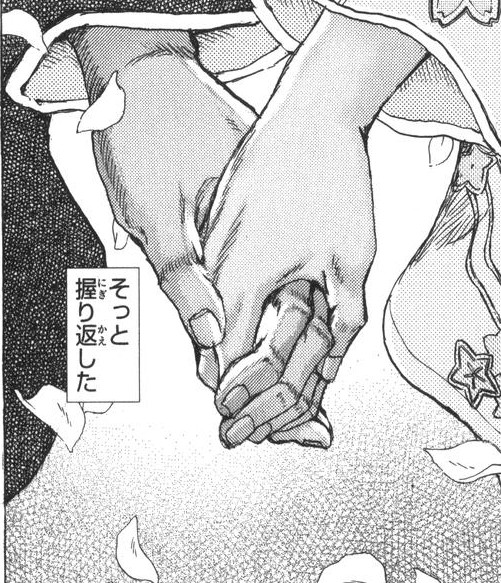
The promise sits on unstable ground. In volume thirteen, Kasahara, who helps Fujiki find employment, kills a married couple under orders. Fujiki and Mie are falsely told that the couple have found employment, and celebrate the news. A peaceful household has been destroyed without their knowledge. The force that could command its destruction is also the force to which they are entrusting their own future.
The duel ends before the story does
Fujiki defeats Irako at the tournament. The encounter brings back the bodily inventions and acts of anticipation built over the whole series. Crucially, the manga continues. Just as Fujiki can finally acknowledge what his opponent means to him, he is ordered to cut off Irako’s head for a degrading public display.
Irako has become a source of pride to him. Yet the demand to act as a samurai, joined to the memory of his teacher, pulls him back into obedience. Having survived a virtuoso fight, he weeps as he works his blade against the other man’s corpse. The painful, clumsy action after the triumph shows who commands the sword.
Mie takes her own life. She does not give a complete explanation of her reasons. I would not reduce the ending to a claim that she had secretly loved only Irako all along. Her shared hardship with Fujiki and the promise beneath the blossoms occupy too much of the story to disappear so neatly.
My reading is that she has just witnessed command take precedence over the promise of a life together. This is an interpretation of the sequence, not a definitive statement of her unspoken thoughts. The final return to the blossoms and joined hands is not an epilogue in which the pair come back to life. It leaves us with the memory of a possible future, and the size of what has been lost.
The account attributed within the manga to the Dainagon Hiki also reduces the duel to a record stripped of the experience we have just read. Treating that document as independent historical verification misses the force of the juxtaposition. Fifteen volumes have given the reader something that a winner’s name and a result cannot preserve.
The final volume closes the Mumyo Sakanagare arc. This is not a manga that goes on to stage every tournament pairing announced at its opening. The central rivalry reaches its conclusion, but the question with which we approached it has changed. Which man is stronger? By the end, I was asking why someone so strong could not choose to live with the person he loved. That question stays after the sword is put away.
06
Read the Japanese manga
This review covers all fifteen volumes of the original Japanese Champion RED Comics edition from Akita Shoten. The links below lead to the official Japanese series page and the publisher listing for the first collector’s volume. A new Japanese collector’s edition began publication in 2026; its volume divisions and pagination should not be assumed to match the fifteen-volume edition used here.
As of 19 November 2026, I could not verify an officially published English manga edition. The links below are for the Japanese edition. This describes the official reading routes verified for this review, rather than claiming that no English edition can exist.
Disclosure: Enkeisha may earn a commission from qualifying purchases through affiliate links in this section.