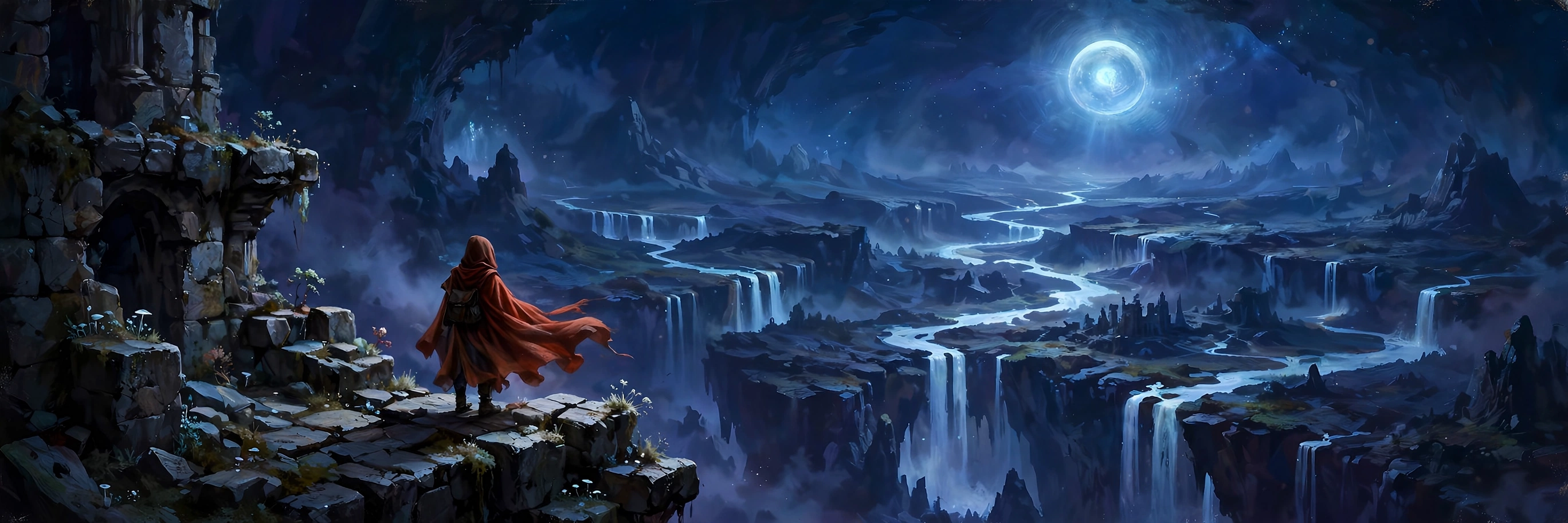
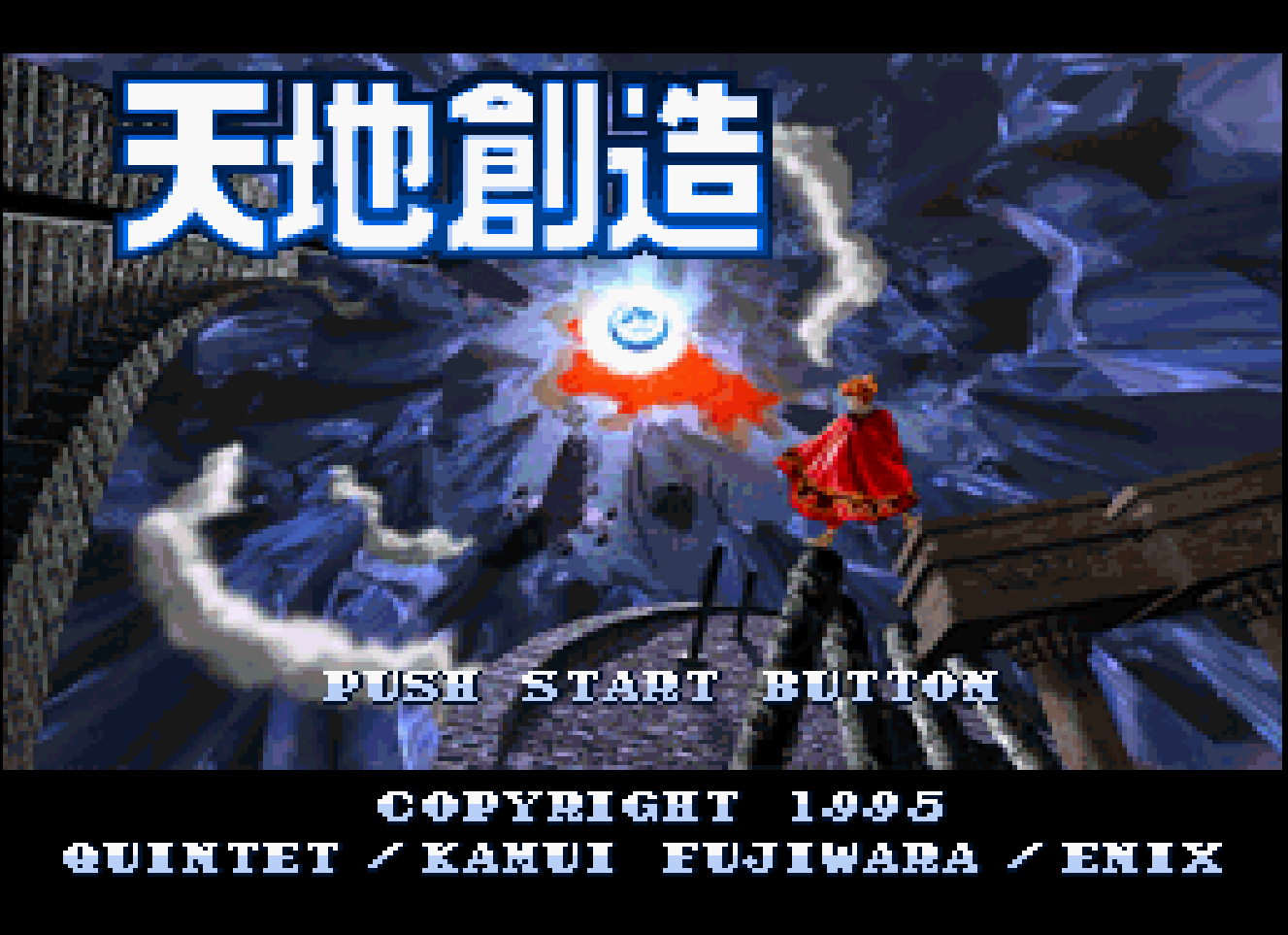
Most RPG heroes save the world. Ark, the troublemaker of the underground village of Crysta, has to create it first — continent by continent, species by species, town by town. Quintet's Tenchi Souzou, released in Japan on October 20, 1995 and in Europe and Australia as Terranigma, is an action RPG about resurrection on a planetary scale: raise the sunken continents, bring back plants, birds, animals and humans, then spend the longest chapter helping civilisation invent itself — elections, telephones, hamburgers, aeroplanes and all.
It is also one of the most famous absences in SNES history: never released in North America, and for over three decades never re-released anywhere. This guide covers the 1995 original in depth — how resurrection works, how towns grow (and how one wrong vote stops them forever), how its consumable magic functions, and how to survive the bosses, above all Bloody Mary, that still stop first-time players cold.
Quick Facts
| Item | Detail |
|---|---|
| Original title | Tenchi Souzou (天地創造, "The Creation of Heaven and Earth") |
| Overseas title | Terranigma (Europe / Australia) |
| Platform | Super Famicom / SNES |
| Release (Japan) | October 20, 1995 |
| Release (PAL) | December 19, 1996, published by Nintendo |
| North America | Never released on the SNES |
| Developer | Quintet |
| Publisher | Enix (Japan); Nintendo (PAL) |
| Director / designer | Tomoyoshi Miyazaki |
| Character design | Kamui Fujiwara |
| Music | Miyoko Takaoka, Masanori Hikichi |
| Genre | Action RPG |
| Cartridge | 32 Mbit (4 MB), HiROM, ROM + RAM + battery save |
| Structure | Prologue + four numbered chapters; five towers in Chapter 1 |
| Series position | Third in the unofficial Quintet trilogy, after Soul Blazer (1992) and Illusion of Gaia (1993) |
Overview
The planet is a hollow sphere with two faces. The outer Lightside — the surface — stands for growth; the inner Darkside — the underworld — for decline. Ages ago the two forces, later called God and Devil, fought to a standstill in Antarctica; the continents sank, life vanished, and the underworld was sealed. When the game opens, the only human settlement left is Crysta, a village inside the Earth.
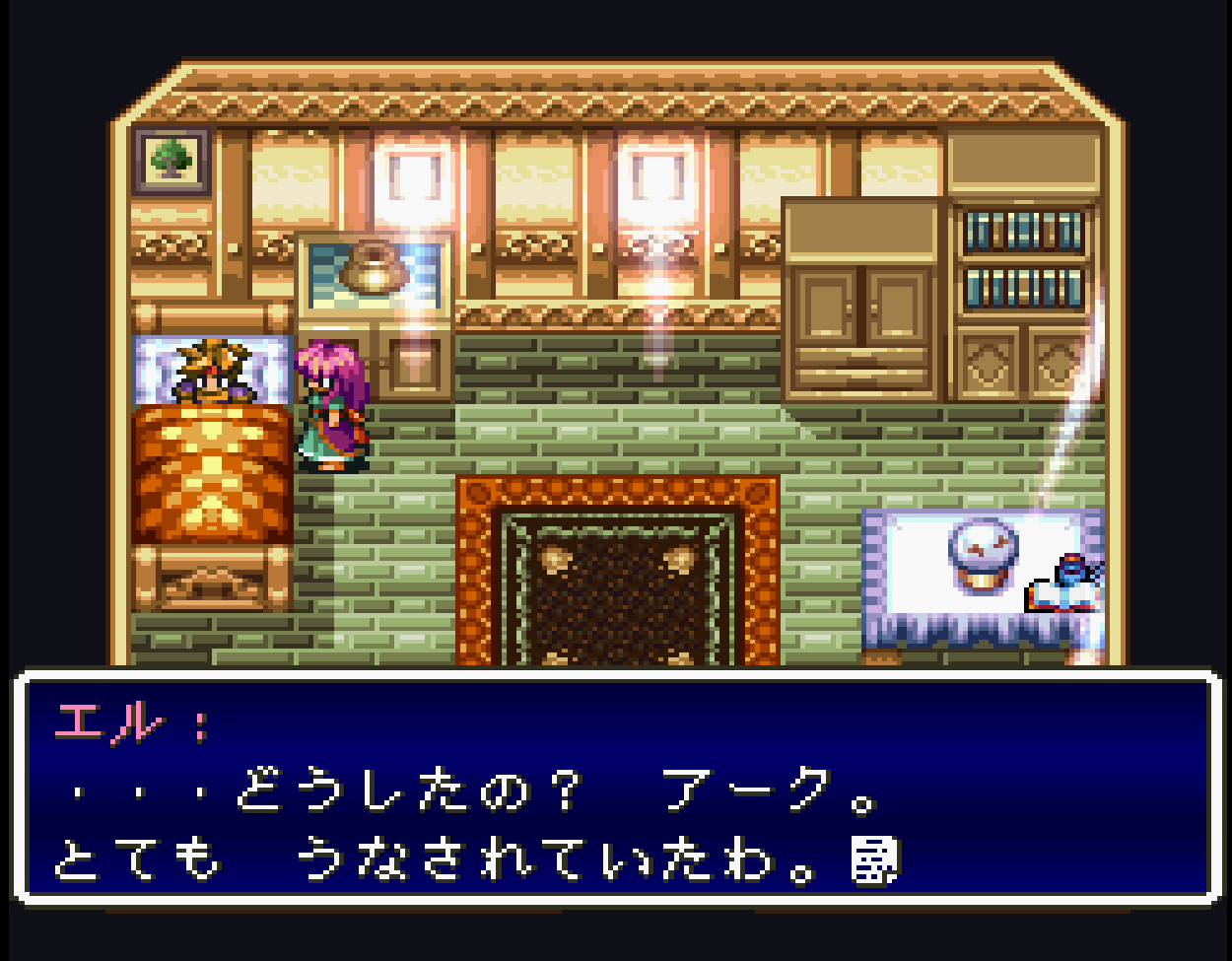
Ark opens a forbidden door, touches a mysterious box, and releases a friendly demon named Yomi — freezing every other villager solid. The Elder sends him out to undo it, and what follows is literal world-building. Five underworld towers each raise one continent. On the barren Lightside, Ark resurrects life in evolutionary order: plants, birds and wind, animals, finally humans. The longest stretch follows humanity's growth across a recognisable Earth — France, Spain, Britain, the Americas, Africa, China, Japan, Australia — curing a mute princess, sailing with Columbus, nudging inventions and towns along. Underneath, the scientist Beruga, woken from cryogenic sleep, plans to remake the world with a virus called Asmodeus, and the voice guiding Ark — the Elder, speaking for Dark Gaia — has been using the resurrection as a weapon.
Moment to moment, this is brisk top-down action: real-time spear combat with five techniques, and a guard blocking projectiles but not melee. There is no MP and no spell list: all magic is single-use rings and pins, bought at magic shops with Magirocks (Japanese version: Prime Blue) plus a small Gem fee. Cast one and its rocks return to your Jewel Box to be exchanged again — an ammunition economy, not a mana bar.
Why It Still Matters
The premise has never really been repeated. Plenty of games let you restore one town; Terranigma makes you responsible for a planet's entire second history — and its final hours, and an ending players still discuss thirty years later, reframe everything the cheerful town-building was doing.
It is also the culmination of Quintet's SNES work: after ActRaiser, Soul Blazer and Illusion of Gaia, their largest action RPG, with a world map modelled on real geography and a celebrated soundtrack. Famitsu scored it 30/40; Quintet reported roughly 200,000 copies sold in Japan. The North American release died when Enix closed its US branch before localisation finished, so for decades the only official English version was Nintendo's 50 Hz PAL cartridge (1996; English, German, French, Spanish) — and Japanese fans were still petitioning for a re-release in 2021, the rights long described as complicated.
That drought finally broke in August 2026, when Clear River Games announced a modern-platform re-release, developed with Square Enix and slated for 2027 — also the game's first official North American release. As of this writing (November 2026) it has been announced but not released, so everything below describes the 1995 original.
Highlights
Resurrection as a system. Continents, species and civilisations return because of things you do — freeing the Ra Tree resurrects all plant life; helping the Kingbird restores the winds carrying you across the map. Progress is visible on the world map itself.
Towns that grow — or don't. Five Chapter 3 towns expand through errand chains linking the whole world: Loire's wine, clothes, painting and camera feed growth in Freedom and beyond. One early election can lock the whole system off for that save file.
A consumable magic economy. No MP, no spell levels: a finite pool of Magirocks, converted into rings and pins, fired, and converted again. A full heal costs four rocks (Grass Pin); invincibility costs six (Water Pin). Budgeting is the skill.
An ending with a reputation. The last chapter recontextualises Ark, Crysta, Elle and Yomi, and its closing scenes are why this game is remembered as more than a curiosity. Go in unspoiled.
Strategy Essentials
The journey in five movements
The game itself numbers four chapters. The table splits the Crysta opening out as a prologue, giving the five-part shape most players remember: a frozen village, five towers, a dead world, a growing civilisation, a reckoning.
| Part | Setting | Purpose |
|---|---|---|
| Prologue | Crysta, the underworld village | Ark opens the forbidden door, releases Yomi, finds the village frozen. The Elder sends him to the five towers. |
| Ch. 1 — The Outset | The underworld (Darkside) | Clear five towers to raise five continents; optionally resurrect Mu and Polynesia; fall through the hole to the surface — no return until Ch. 4. |
| Ch. 2 — Resurrection of the World | The barren surface (Lightside) | Resurrect life in order: Ra Tree (plants), Kingbird at Sanctuar (birds, wind), animals, then mankind in Eklemata. |
| Ch. 3 — Resurrection of the Genius | Human civilisation worldwide | Cure Loire's mute princess, cross to the New World, expand the towns, collect five Starstones — and wake Beruga, whose Asmodeus virus turns the story. |
| Ch. 4 — Resurrection of the Hero | Beruga's airship; the underworld | Ark is reborn, confronts Beruga, returns to the Darkside, and faces Dark Gaia. Winning ends the underworld itself. |
The five towers (Chapter 1)
Short, puzzle-led towers. Clear them in order — the difficulty assumes it — and sweep every room for Magirocks; the underworld's rocks are easy to leave behind for a long time.
| Tower | Continent raised | Notes |
|---|---|---|
| Tower 1 | Eurasia | Tutorial tower; the Guardian encounter is four Red Huballs. Treat it as combat practice. |
| Tower 2 | South America | Statue-and-switch puzzles; no major boss. |
| Tower 3 | Africa | Guardners can send you back to the start. Take the Sleepless Seal here. |
| Tower 4 | North America | The Crystal Thread here is essential: give it to Elle in Crysta and, after resting, she weaves the Elle Cape needed for Tower 5. |
| Tower 5 | Australia | The first real boss, the Shadowkeeper (boss table below). Enter wearing the Elle Cape or the Guardian's spell throws you out. |
Two extra resurrections hide in Chapter 1: Polynesia, south of Tower 4, and Mu, far north of Tower 3. Both are optional, easiest before the hole, and worth it for Magirocks and experience.
Crysta ► Tower 1 Eurasia ► Tower 2 S. America ► Tower 3 Africa
                                                      │
   Mu (optional, far north of Tower 3) ◄──────────────┘
                                                      │
   Tower 4 N. America ► Crystal Thread ► Elle Cape ► Tower 5 Australia
                                                      │
   Polynesia (optional, south of Tower 4) ► The Hole ► SURFACE (no way back until Ch. 4)
Combat basics: five attacks and a one-purpose guard
| Technique | Input in effect | Use it for |
|---|---|---|
| Standard | Attack standing | Safe pokes; your corridor default. |
| Slicer | Attack while dashing | A running pass that hits without stopping — the key technique vs. Bloody Mary: damage without standing in her reach. |
| Slider | Attack while dashing and jumping | A leaping dash strike vs. enemies that punish ground approaches. |
| Rushing | Repeated attack presses | A point-blank flurry; best on staggered targets, dangerous vs. counterattackers. |
| Spinner | Attack while jumping | An aerial spin covering around Ark; good vs. swarming fliers. |
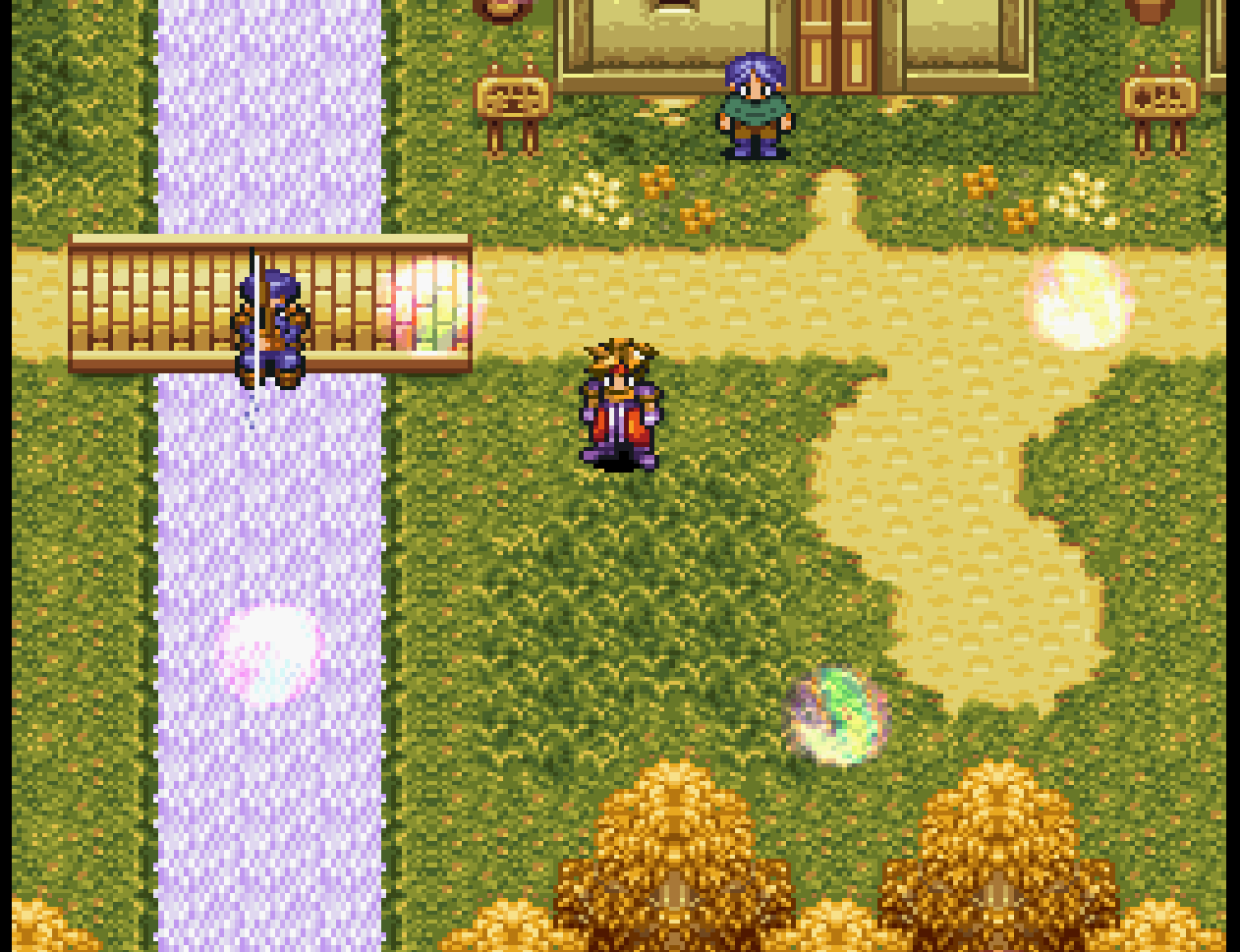
Guarding blocks projectiles only — never melee — but that job is vital late: blocking Dark Gaia's lightning beam reduces it to a scratch. Two rules govern everything below. Damage is level-driven: hits landing for 1–2 points mean no tactic saves you — gain a level or two, because level-ups here are large. And healing is item-based and instant from the menu, so your real health bar in a boss fight is your stock of Bulbs.
Resurrection and development: how towns grow
Town expansion lives in Chapter 3 and is almost entirely optional: the rewards are new shops, better gear, Magirocks, an apartment, and watching the world change. It works in stages — finish a town's errands, leave, re-enter later to find it rebuilt. The towns form a supply chain and must largely grow in order, Loire first, because Loire produces what everyone else needs.
| Town | How it grows | What growth unlocks |
|---|---|---|
| Loire (France) | The election: vote Jean, not Louis. Then export errands — winery Wine to Freedom's pub, Marily's Fancy Clothes to three girls in Freedom, Matis's Painting to Rich in Britain, Pierre's Camera. The final stage also needs Freedom at stage 2. | Bigger weapon/magic shops (stage-2 Loire stocks the Icepick), a tourism bureau, a real-estate office where Ark can buy and furnish an apartment, and the Camera other towns' tourism quests need. |
| Freedom (N. America) | Stage 1: carry Bell's message to Amanda in Nirlake, tell him the truth; Bell invents the telephone, and pushing Eddy's machine leads him to electricity. Stage 2: help both again, and settle the Yunkou metal-prices affair (main story) so Will finishes his plane. | Higher shop tiers (top stage: Light Pike, X-Spear lottery), an airport, and the shop basement's black market: 5,000 Gems frees the captive Kingbird — return to him at Sanctuar for a Magirock. |
| Litz (Spain) | Tin Sheet (Will's house) to the sardine preserver; Tinned Sardines to Stoma in Freedom; a Crystal from the Sahara oasis caravan to the church artist. | Guides disagree whether Litz grows once or twice, and it never modernises like the big cities: treat it as one stage, two errands, valued as progress for the other towns. |
| Nirlake (N. America) | Help Mick invent the hamburger (grind the meat, in a bun). Later, after Nirlake burns, deliver nine Letters to nine wealthy people: Rich (Britain); Marily, Matis, Pierre, the winery owner (Loire); the sardine merchant (Litz); Bell, Eddie (Freedom); Will. | A rebuilt town — and the chain's capstone, since recipients count as "wealthy" only once their own towns have grown. The letters are why Loire and Freedom come first. |
| Suncoast (Australia) | Tasty Meat to Stoma in Freedom; Will's Airfield Plans to the town council; Camera tourism photos to the other towns' tourism bureaux. | An airfield (one of only three worldwide) and the stage-2 shop selling the Alpha Rod. |
| Sanctuar | Does not expand. It is a hub, not a town: the Kingbird's nest, a magic shop, and bird travel across the map (eight landing spots in the Japanese guide's count, Windvale to Greenland). | Bird travel itself — fast access to much of the Ch. 2–3 map — plus an early ring shop. |
The one irreversible choice in the game is the Loire election. Vote Louis and Loire never expands — permanently, on that save — strangling every town downstream of its exports. Jean is not a matter of taste; he is the only vote compatible with the development system at all. Vote Jean, leave, re-enter, and watch the first expansion happen.
Deadline warning. Development, Starstones and shopping must be finished before the late point of no return: once Ark flies back to the underworld, the surface closes for good. Make a final circuit of Loire, Freedom and Suncoast, fill your Bulbs, and convert spare Magirocks before you commit.
Magic: Magirocks, rings and pins
There is no MP. Every spell is a one-time-use item made at a magic shop: hand over Magirocks plus a small Gem fee, use the ring or pin, and the rocks return to your Jewel Box to be exchanged again. Your rock pool is your casting capacity, and it only grows by finding more — exploration pays twice. Counts differ by version and source: PAL completion lists count 96 Magirocks; the Japanese version has one extra (a quiz prize in Neo Tokio's Quintet building), for 97. An older shrine's list runs to 97 entries and repeats an unconfirmed rumour of 100 — treat rounder numbers with suspicion.
Gem fees follow the widely used GameFAQs ring list; fees vary slightly between shops, but the Magirock costs — the number that matters — are consistent.
| Ring / Pin | Magirocks | Gem fee (listed) | Effect and best use |
|---|---|---|---|
| Fire Ring | 1 | 5 | Basic fire blast. Also the tower trick: Fire Rings destroy the Shadowkeeper's claws. |
| Ice Ring | 1 | 5 | Basic ice shot; cheap early filler damage. |
| Geo Ring | 1 | 10 | Earthquake; ground-bound groups only. |
| Ray Ring | 1 | 15 | A light orb — among the few attack spells guides rate vs. bosses where magic can be used at all. Note: it cannot be used in the Dark Gaia fight; Dark Gaia's first form is hurt by deflecting the boss's own light orbs with the spear, not by this ring. |
| Zap Ring | 2 | 9 | A lightning strike. |
| Pyro Ring | 2 | 15 | The stronger flame spell. |
| Snow Ring | 2 | 15 | A blizzard spell. |
| Elec Ring | 2 | 30 | Lightning striking all enemies on screen. |
| Boom Ring | 3 | 25 | Zaps all foes; the heavy area option. |
| Sky Ring | 3 | 30 | The top attack ring — "voids all foes," in the game's description. Save it for screens that would otherwise cost Bulbs. |
| Grass Pin | 4 | 20 | The spell most guides treat as the most important in the game: the Ra Tree's healing spell, restoring all HP. Received from the Ra Tree after Ch. 2's opening; full heals on demand make long dungeons survivable. |
| Wind Pin | 2 | 10 | Cures all status abnormalities at once. |
| Bone Pin | 1 | 30 | Kumari's teleport: escape any dungeon to the world map. Always carry one. |
| Horn Pin | 4 | 50 | Temporary shield vs. special attacks/status. Boss-fight insurance. |
| Water Pin | 6 | 65 | Temporary invincibility — the priciest spell in the game. A luxury for situations where pins can be used; it cannot be used in the Dark Gaia fight, so do not save it for the finale. |
Doctrine, borne out by most guides: offensive rings are situational and several bosses shrug them off. The loadout that carries players is Grass Pin first, Bone Pin second, utilities after, with Fire Rings early (Shadowkeeper) and Elec Rings where guides call for them — notably Bloody Mary. Set your active item before the fight, not during it.
Boss essentials
Levels are guidance, not gospel: guides disagree by several levels on the famous fights, because two levels here can turn a wall into a walkover. Every guide shares the 1–2 damage test — hitting for 1–2 points means stop, level up, come back.
| Boss | Where | How to win |
|---|---|---|
| Shadowkeeper | Tower 5 (Ch. 1) | Dodge the lasers, destroy both claws (Fire Rings work), then strike mouth and head as they are exposed, then tail and head. Elle Cape required to start the fight. |
| Parasite | Ra Tree (Ch. 2) | Whack the claw growths in the side holes until the snake retreats; then hit the great eye with the rushing attack whenever it surfaces. |
| Dark Twins | Grecliff (Ch. 2) | Cliff-top; falling restarts the battle. Focus the green bird through flame feathers, dives and edge-blowing whirlwind; when the brown bird joins, keep hitting the green one. |
| Storm Master | Zue (Ch. 2) | Two forms ("Stormkeeper" in some sources). Skeleton form: dodge green flames, strike the stomach when it throws its arms. After the fall, avoid flames and rocks, hit it as it closes. |
| Dark Morph | Eklemata (Ch. 2) | Shape-shifter; Neo's Fang recommended. Yeti: walk against the blizzard in a corner. Wizard: knock its orbs back. Humanoid: hit-and-run; dash-attack when it splits into bats. |
| Bloody Mary | Sylvain Castle (Ch. 3) | The wall — 350 HP in the RPG Classics shrine's table. Slicer through her so you never stand in range; bring Elec Rings; equip light: the shrine recommends the Light Pike, but in a normal run the Light Rod (Light, STR +15) is what most players own here — one reason advice varies. Recommended levels scatter from the high teens to 25+; conservative advice is the mid-20s. If she deletes you, the fix is levels and L. Bulbs. Reward: freeing Columbus. |
| Hitoderon | Great Lakes Cavern (Ch. 3) | Three starfish. Ignore Gossie, the friendly dragon — it never hurts you and burns a starfish off your head. Kill climbers on your platform; for the last, stand beneath it, sidestep the drop, strike while down. |
| Security Robot | Beruga's Lab (Ch. 3) | The late gear check: guides advise level 28+ and deep M./L. Bulb stocks. Run constantly vs. missiles; block the whiplash arm (other arm attacks must be dodged); destroy the three legs; finish the small machines it becomes with the Slider. |
| Dark Gaia | Gaia Stone (Ch. 4) | Two forms. Rings and pins cannot be used in this fight — multiple walkthroughs state that magic is not possible here, so prepare Bulbs and rely on equipment and levels instead. Form one (crystal statue): keep moving vs. Gaia's Rage, stand at the platform edge for the sonic boom, and at first hurt it only by returning its light orbs with the spear; when it curls into a ball, unload. Form two (1,000 HP, shrine table): sparks and a lightning beam — block the beam to cut it to a few HP. Hero Pike and Armour equipped, level 32+ per guides, with a deep stock of Bulbs. |
Levels and equipment
Levels run 1 to a cap of 50; Life caps at 999 (reached by levelling in the mid-40s). A normal playthrough finishes in the low-to-mid 30s — all the game asks. The stretch to 50 demands disproportionate grinding for single-digit gains: a completionist project, not a strategy. For almost every difficulty spike, Bloody Mary above all, the correct response is one or two levels.
All weapons are one family — spears, pikes, rods and staves used as spears — so progression is a ladder, not a build. STR bonuses below agree across the standard item FAQs and equipment lists:
| Weapon | STR | Element / note | Source |
|---|---|---|---|
| Crystal Spear | +3 | Slowly restores HP while equipped — underworld only; the Elder warns it will not heal on the surface. | Crysta (starting weapon) |
| Ra Spear | +6 | First real upgrade. | Ra Tree / Evergreen |
| Roc Spear | +8 | Earth; shatters large boulders — a progression tool too. | Great Cliff |
| Fire Pike | +14 | Fire. | Eklemata |
| Light Rod | +15 | Light; the realistic light weapon for Sylvain Castle. | Louran; sold in Loire |
| Bronze Pike | +17 | The reliable shop-bought mid-game standard. | Loire, other towns |
| Silver Pike | +22 | Noted vs. wolves. | Loire |
| Icepick | +25 | Ice; a dungeon find that also appears in expanded Loire's shop. | Sylvain Castle |
| Thunder Pike | +35 | Thunder. | Suncoast / expanded Freedom |
| Sea Spear | +37 | The mermaids' favoured weapon. | Mermaid Tower |
| Dragon Pike | +40 | — | Sold in Yunkou |
| Light Pike | +51 | Light; the strongest light weapon, and the developed-town Bloody Mary recommendation. | Fully expanded Freedom, 4,350 Gems (equipment list) |
| Fauchard | +58 | Strongest findable spear before the finale. | Neo Tokio Sewers |
| Hero Pike | +80 | Highest STR bonus in the standard equipment lists (+80). Not bought or dropped: handed to Ark with the Hero Armour in the surface village mirroring Crysta, on the road into the finale. Guides name the place differently — Storkolm (older FAQs) vs. Norfest (PAL walkthroughs). | Ch. 4, story-given |
The Hero Armour (DEF +88, the highest in the standard lists) arrives with it; the pair is the intended Dark Gaia loadout — reach the final boss without them and you have walked past a story handout, so retrace the Ch. 4 village sequence rather than grinding. Earlier, respect two things: the Crystal Spear's regeneration carries the underworld chapter, and the shop ladder (Bronze → Silver → Thunder → Dragon Pike) is gated by town development — the practical reason to grow Loire and Freedom even if you skip every other errand.
Finally, Ch. 3's five Starstones, set at the grave at Time's End (Dryvale, South Pole) to summon the legendary hero, are found in the Neo Tokio sewers, at Astarica, in Penguina (Greenland), at Airs Rock (Australia), and with the Sahara caravan. None is missable before the point of no return; all are unreachable after it — collect them on the same final circuit as your town business.
Who It's For
Players who love Soul Blazer and Illusion of Gaia and want the trilogy's biggest, strangest conclusion; action-RPG fans who enjoy systems — town chains, consumable magic, level-driven boss checks — more than tutorials; and anyone who likes watching a world visibly grow because of their errands. Completionists get a finite checklist: Magirocks, towns, Starstones. If you need quest markers, or a difficulty curve that never asks you to gain two levels, this original will feel austere. Its rewards are structural, not presentational — and considerable.
How to Play It Today
The original is a Japanese Super Famicom cartridge (PAL Terranigma likewise needs PAL hardware), so the 1995 version today means original or compatible hardware — and, in Japanese, reading Japanese. Second-hand copies of both versions circulate; check the battery save still holds before paying collector prices.
For the future: a re-release for modern platforms (Switch and Switch 2, PlayStation 4 and 5, Xbox Series X|S, PC via Steam and GOG) was announced by Clear River Games in August 2026, in cooperation with Square Enix, slated for January 14, 2027, including the first official North American release. As of November 2026 it is announced, not released — confirm dates and features against the publisher's current listing. Until it lands, the cartridge is the game.
Related Reading
- Soul Blazer — the first entry in Quintet's unofficial trilogy
- Illusion of Gaia — the second entry, and Terranigma's direct predecessor
- Our retro RPG coverage and more Super Famicom strategy features
Editorial note: Basic specifications (internal title, capacity and memory configuration) are based on confirmation of the cartridge header information. Strategy content is based on published sources. No extracted images are used.
Game screenshots captured by the author. ©SQUARE ENIX.
Find original hardware editions on eBay
As an eBay Partner Network affiliate, Enkeisha may earn a commission from qualifying purchases made through these links.
Search eBay listings (affiliate link)
Check the language, region, hardware compatibility, condition and authenticity before buying. Search results may include reproductions; links do not endorse individual sellers.