Panel de Pon: The Puzzle Masterpiece the West Almost Didn't Get
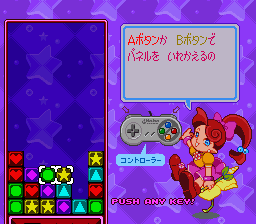
Swap two panels. Clear three. Then watch the whole stack collapse into a chain you barely planned — that's Panel de Pon, the Super Famicom puzzler that quietly invented a genre.
| Quick facts | |
|---|---|
| Japanese title | パネルでポン (Panel de Pon) |
| Western title | Tetris Attack (SNES, reskinned with Yoshi characters) |
| Platform | Super Famicom / SNES |
| Release | October 27, 1995 (Japan) |
| Developer | Intelligent Systems |
| Publisher | Nintendo |
| Genre | Tile-matching action puzzle |
| Players | 1–2 |
Overview
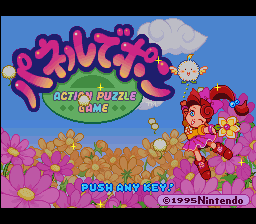
Panel de Pon looks like a falling-block game, but nothing falls. Instead, a stack of colorful panels rises steadily from the bottom of a well that is six panels wide and twelve tall. You control a two-panel cursor and swap neighboring panels horizontally — including swapping a panel into an empty space. Line up three or more panels of the same type, vertically or horizontally, and they clear. If the stack touches the top, it's over.
There are five main panel types (heart, circle, star, diamond, and drop), with a sixth joining at higher difficulty levels. The genius of the design is that you are never waiting for the "right piece" to drop: every tool you need is already on the board, and speed comes from your eyes and hands, not luck.
The 1995 cartridge packs in a remarkable amount of game:
- Endless — survive as the stack rises faster and faster.
- Score Attack — two minutes, maximum points.
- Stage Clear — clear panels until the stack drops below the Clear Line, stage after stage.
- VS COM — a story ladder: the fairy Lip battles her possessed friends one-on-one to lift a curse from their world.
- 2P VS — head-to-head against a friend, the mode the game is truly built around.
- Puzzle — 120 designed puzzles (60 "front" puzzles and 60 "reverse" ones unlocked by password), each asking you to clear the entire board within a fixed number of swaps.
Why It Still Matters
Panel de Pon is the founding game of the Puzzle League series, and its core ideas — the rising stack, the swap cursor, player-built chains — became a design language that action-puzzle games still speak today. For decades, though, the original fairy-themed version was effectively Japan-only: the West received the same game wearing a Yoshi costume as Tetris Attack, and the unaltered Panel de Pon didn't officially leave Japan until Nintendo added it to the Super NES app for Nintendo Switch Online on May 20, 2020 — worldwide, untranslated, and completely intact. If you've only ever played a reskin, this is a small piece of puzzle history finally within reach.
Highlights
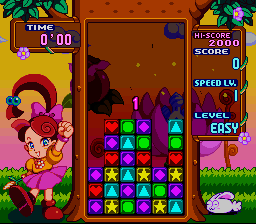
- Chains are the soul of the game. A combo is clearing four or more panels at once. A chain is smarter: one clear drops panels into a second clear, which drops panels into a third. Chains are worth far more points — and in VS play, they drop far bigger garbage on your opponent.
- Garbage blocks are a comeback engine. In VS modes, combos and chains dump gray garbage blocks onto the other player's stack. Garbage can't be swapped, but clearing a group of panels touching it converts it into ordinary panels — which can immediately start a chain of your own. Being buried is a threat; it's also raw material.
- The "!" panels. At higher levels, special surprise panels appear that can trigger instant clears and huge garbage — a built-in chaos factor that keeps VS matches volatile.
- Puzzle mode is a second game. With no rising stack and a strict swap limit, the 120 puzzles play like chess problems: quiet, exact, and deeply satisfying.
Strategy Essentials
Chains vs. combos — know what you're building
| Play | What it is | Points value | Garbage sent (VS) |
|---|---|---|---|
| Clear of 3 | One match of three panels | Low | None |
| Combo | 4+ panels cleared in one match | Medium | Small garbage |
| Chain ×2, ×3… | Consecutive clears caused by falling panels | High, scaling | Thicker garbage per link |
| Long chain (13+) | Extreme chain | Maximum | Maximum thickness — twelve rows of garbage |
How a chain works (concept diagram)
Frame 1          Frame 2             Frame 3
. . . . . .      . . . . . .         . . . . . .
. . B . . .      . . . . . .         . . . . . .
R R . B . .  →   R R B . . .     →   . . . . . .   ← the three B panels
B B . B . .      B B B . . .            fall and clear: CHAIN ×2
                 └─ reds clear,
                    blue drops in
Read it left to right: the first clear (reds) removes support, the blue panel falls, completes a vertical three, and clears again. Every chain in the game is built on this single idea — clear something so that something else falls into place.
Five habits that win games
- Learn the "active chain." While panels are clearing or falling, you can keep swapping. Experts don't wait for a chain to finish — they feed it, moving the next piece into position mid-animation. This is the single biggest skill jump in Panel de Pon.
- Play low, not high. A lower stack gives falling panels more room to land in useful places and keeps garbage survivable. Clear from the top of your stack downward when you can.
- When garbage lands, clear next to it immediately. The converted panels appear in a fixed pattern; if you already see a match forming among them, you're not defending — you're counterattacking.
- In Stage Clear, only the line matters. Ignore score; everything above the Clear Line has to go, so prioritize wide horizontal clears over fancy chains.
- In Puzzle mode, count from the last move backwards. With a fixed swap budget, find the final clear first, then work out which swap sets it up. Brute-forcing forwards is how swaps run out.
Who It's For
- Puzzle players who find falling-block games too passive — here, you build every clear.
- Anyone who loves a high skill ceiling in a game a child can learn in one minute.
- Retro fans curious about the true original behind Tetris Attack and Pokémon Puzzle League.
How to Play It Today
- Nintendo Switch Online (easiest): Panel de Pon is in the Super Nintendo Entertainment System – Nintendo Switch Online library worldwide. It's the original Japanese version, menus and all — the gameplay needs no translation.
- Original cartridge: the Super Famicom cartridge is common and inexpensive in Japan.
- The Western twin: Tetris Attack (SNES, 1996) is the identical game with Yoshi characters — a fine alternative if you prefer an English release.
Find the original Japanese cartridge
Disclosure: The Rakuten and Yahoo! Shopping links are standard shopping links. Enkeisha does not earn a commission from purchases made through these links.
Find original hardware editions on eBay
As an eBay Partner Network affiliate, Enkeisha may earn a commission from qualifying purchases made through these links.
Search eBay listings (affiliate link)
Check the language, region, hardware compatibility, condition and authenticity before buying. Search results may include reproductions; links do not endorse individual sellers.