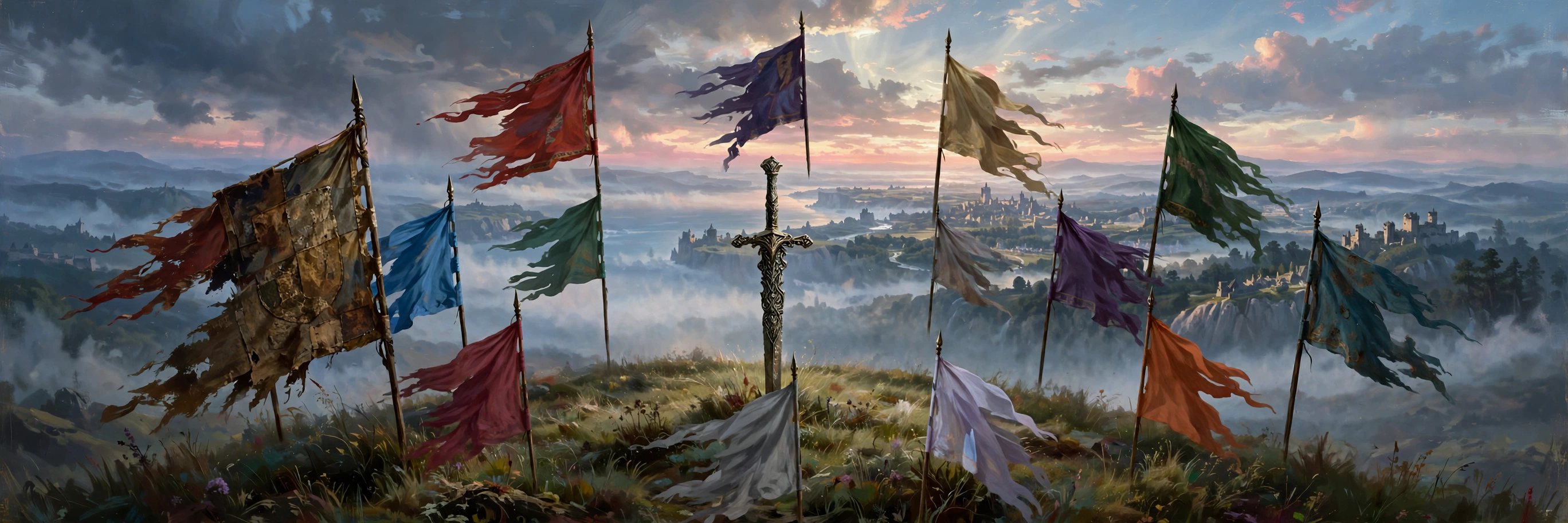
Most strategy RPGs end when the hero wins. Fire Emblem: Genealogy of the Holy War (1996) is built around the opposite idea: the first hero cannot finish his war, and the second half belongs to his son. Between the halves sits the series' most consequential system — you choose who falls in love, who marries, and therefore who your second army even is. Bloodlines are not lore here: they are growth rates, weapon ranks, skills, inventories, and the only keys to the twelve holy weapons.
It is also the great missing Fire Emblem for English-speaking players: Japan-only, never officially translated, and known in the West through fan translations and reputation alone. This guide covers the 1996 original — how its generations fit together, how holy blood and inheritance work, and where a first playthrough goes wrong.
Quick Facts
| Item | Detail |
|---|---|
| Title (Japan) | Fire Emblem: Seisen no Keifu (ファイアーエムブレム 聖戦の系譜) |
| English title | Fire Emblem: Genealogy of the Holy War (conventional translation; the game has no official English release) |
| Platform | Super Famicom (Japan only) |
| Release (Japan) | May 14, 1996 |
| Developer | Intelligent Systems |
| Publisher | Nintendo |
| Genre | Tactical / strategy RPG |
| Cartridge | 32 Mbit (4 MB), battery-backed save RAM |
| Series position | 4th main entry; set on the continent of Jugdral, in a world separate from the earlier games |
| Structure | 12 chapters — Prologue + Chapters 1–5 (first generation), Chapters 6–10 + Endgame (second generation) |
| Playable cast | 24 units in the first generation; the second generation fields children or their substitute counterparts (62 playable characters in total across the game, counting children and substitutes separately) |
| Later re-releases (Japan only) | Nintendo Power flash service (1997), Wii Virtual Console (2007), Wii U Virtual Console (2013), New Nintendo 3DS Virtual Console (2016), Super Famicom – Nintendo Switch Online (2021) |
| Official English release | None — English-speaking players rely on fan translations |
| Remake | None as of writing |
Overview
The setting is Jugdral, a continent of kingdoms founded by descendants of the Twelve Crusaders — warriors who, centuries earlier, drank the blood of dragons at the Miracle of Dahna and received holy weapons bound to their bloodlines. In the first generation you command Sigurd, heir of Chalphy in Grannvale, whose border rescue mission pulls him into a continent-wide war and a political trap. In the second, you command his son Seliph, raised in hiding, leading the liberation army Sigurd never could.
The scale is the first thing that feels different. There are only 12 chapters, but each is a small campaign: one enormous map, several castles to seize in sequence, villages to protect from bandits, and armies counter-attacking across the whole theatre. Your home castle is your headquarters — units deploy from it and return to it for the arena, weapon repairs and the pawn shop — and roads speed movement, which is why cavalry dominates open ground.
The systems match the scale. This game introduced the weapon triangle and the skills system to Fire Emblem. Doubling is not automatic: it requires the Follow-Up (Pursuit) skill. Money is personal — every unit carries their own purse — and there is no trading: to move an item between units you sell it to the pawn shop and buy it back with the other unit. Weapons can be repaired at a blacksmith instead of discarded, so a good sword is an investment a parent can hand down to a child.
Why It Still Matters
First, the two-generation structure remains unmatched. Later games borrowed pairing and children, but none repeated the full commitment: an entire first army, replaced wholesale by its children, whose stats, skills, blood and equipment are the direct arithmetic of decisions you made twenty hours earlier. The first generation's tragedy lands harder because you built the generation that has to avenge it.
Second, it is designer Shouzou Kaga's most systems-dense Fire Emblem — skills, the weapon triangle, holy blood, personal gold, repair, non-lethal arenas, dancers who refresh every adjacent ally at once — and a striking number of its experiments became series furniture afterwards.
Third, its absence shaped its legend. Because it never left Japan, Genealogy became the series' word-of-mouth epic: huge maps, a doomed first hero, the marriage system, and a story darker than anything the localised games attempted in 1996. Playing it today is partly archaeology — this is where ideas the whole genre now uses were first assembled into one design.
Highlights
1. Maps the size of wars. A single chapter can contain several castle seizures, a home-castle defence, a village rescue race and a boss duel on one continuous map. Strategy here is logistics as much as tactics.
2. An arena that trains instead of punishing. Every unit may fight up to seven arena bouts per chapter, from inside a castle. Defeat leaves the unit at 1 HP rather than killing them, so the arena is the intended engine for gold and experience — up to 17,500 gold per unit per chapter for clearing all seven bouts.
3. Dancers who refresh a formation. Silvia (first generation) and her daughter or substitute counterpart (second generation) refresh all adjacent allies with one dance — up to four units at once. Positioning around the dancer is a core tactical skill, not a gimmick.
4. Holy weapons that feel holy. The twelve crusader weapons grant huge stat bonuses and turn their wielder into a one-unit army. The catch — only the major-blood heir of the matching line can lift one — is the subject of the strategy section below.
Strategy Essentials
1. Chapter Structure — Two Generations, Twelve Campaigns
Every chapter is won by seizing the final castle listed; you must also hold your home castle, and losing the lord (Sigurd, then Seliph) means defeat.
| Chapter | Title | Generation | Final seizure | What defines it |
|---|---|---|---|---|
| Prologue | Birth of a Holy Knight | 1st — Sigurd | Evans | A border rescue; introduces castle seizing |
| Chapter 1 | Lady of the Forest | 1st — Sigurd | Verdane | Verdane invasion; Ayra's recruitment (see §4) and the Spirit Forest meeting |
| Chapter 2 | Crisis in Agustria | 1st — Sigurd | Agusti | Village races, Lachesis to protect, Lewyn and Erinys, an arena recruit |
| Chapter 3 | Eldigan, the Lionheart | 1st — Sigurd | Orgahil | The Cross Knights crisis; Brigid, Tailtiu and Claud join |
| Chapter 4 | Dance in the Skies | 1st — Sigurd | Zaxon | Silesse civil war — pegasus squadrons strike while your army is strung out |
| Chapter 5 | Doorway to Destiny | 1st — Sigurd | Belhalla (the chapter actually ends by talking to Aida at Velthomer) | Byron entrusts Sigurd with the broken Tyrfing; Quan and Ethlyn appear only as non-controllable partner units and fall in the Yied Massacre; then the road to Belhalla and the generation's end |
| Chapter 6 | Inheritors of Light | 2nd — Seliph | Ribaut | The children debut; the Iuchar / Iucharba choice (only one brother joins) |
| Chapter 7 | Beyond the Desert | 2nd — Seliph | Ulster | Leif's understrength army joins; the Yied Desert crossing; Ares and Shannan |
| Chapter 8 | The Wyvern Knights of Thracia | 2nd — Seliph | Meath | Munster campaign; Febail and Ced (or substitutes) join; Ishtar appears with Mjölnir |
| Chapter 9 | For Whose Sake | 2nd — Seliph | Thracia | Three recruitments with strict conditions: Altena, Coirpre/Charlot, Hannibal (§4) |
| Chapter 10 | Light and Dark | 2nd — Seliph | Chalphy | Return to Grannvale; Seliph receives the Tyrfing; Arvis at Chalphy |
| Endgame | End of the Holy War | 2nd — Seliph | Belhalla | The Deadlords, Julia to recover alive, and Julius with the Loptous tome |
A note on names: fan translations and older guides differ in places (Chapter 1 is also rendered "Girl of the Spirit Forest"). The Japanese titles are the only fixed ones.
2. Holy Blood — The Twelve Bloodlines and Their Weapons
Holy blood comes in two grades. Minor blood grants growth-rate bonuses and raises the bearer's weapon rank by one in the bloodline's weapon type. Major blood doubles the bonuses, grants the top weapon rank automatically, and — decisively — is the only thing that lets a unit wield that bloodline's holy weapon. Wrong blood, or only minor blood, means the weapon cannot be equipped at all.
| Bloodline | Crusader | Holy weapon | Main bearer line in the story |
|---|---|---|---|
| Baldr | Baldr | Tyrfing (sword) | House Chalphy — Sigurd (major), Seliph (major) |
| Naga | Heim | Book of Naga (light tome) | Imperial house of Belhalla — Deirdre (major), Julia (major) |
| Höðr* | Höðr | Mystletainn (sword) | House Nordion, Agustria — Eldigan (major), Ares (major), Lachesis (minor) |
| Od | Od | Balmung (sword) | Royal house of Isaach — Shannan (major), Ayra (minor) |
| Njörun | Njörun | Gáe Bolg (lance) | Royal house of Leonster — Quan (major), Leif (minor), Altena (major) |
| Dáinn | Dáinn | Gungnir (lance) | Royal house of Thracia — Travant (major), Arion (major), on the enemy side |
| Nál* | Nál | Helswath (axe) | House Dozel — Lex (minor); Danann (major) leads the enemy occupation of Isaach |
| Ullr | Ullr | Yewfelle (bow) | House Yngvi (Jungby) — Brigid (major), Edain (minor) |
| Bragi | Bragi | Valkyrie (staff) | House Edda — Claud (major) |
| Fjalar* | Fjalar | Valflame (fire tome) | House Velthomer — Arvis (major), Azelle (minor); Arvis's children carry it as minor blood |
| Thrud | Thrud | Mjölnir (thunder tome) | House Friege — Ishtar (major), on the enemy side; Tailtiu (minor) |
| Forseti | Ced | Forseti (wind tome) | Royal house of Silesse — Lewyn (major); his son inherits major blood (see §3) |
\*Transliteration varies by source and era: Höðr also appears as Hezul, Nál as Neir, and Fjalar as Fala in older fan materials. The spellings above follow the more recent references.
The thirteenth line. The blood wheel has a thirteenth position at its centre: Loptous blood — the dragon who empowered the Loptr Empire, not a crusader. Julius carries major Loptous blood (with minor Naga and Fjalar), and his Loptous tome halves the attack power of anyone who fights him — which is why Julia's Book of Naga is the standard answer in the Endgame.
Practical rules that follow from the table:
- A holy weapon is a bloodline key, not loot. Plan pairings so the line produces a major-blood child of the right class — Forseti is only a Silesse heirloom if Lewyn has a son who can use wind magic.
- Holy weapons no heir can claim are effectively lost after Chapter 5, with story exceptions: Seliph receives the Tyrfing by event in Chapter 10, and Altena always inherits the Gáe Bolg.
- Two enemy lines (Dáinn, Thrud) put holy weapons on the other side: a Gungnir or Mjölnir wielder is a boss to route around or overwhelm, never a fair duel.
3. Marriage and Inheritance — How the Second Army Is Built
Falling in love. Opposite-sex pairs accumulate love points, falling in love at 500 points. Points grow by small pair-specific amounts each turn while both units are deployed (growth stops after turn 50 of each chapter), grow faster — a further +5 per turn in reference calculations — when the pair ends the turn adjacent, and jump by large amounts (often +100) through specific conversations, such as Lewyn and Erinys in Chapter 4. Two pairs are fixed: Sigurd and Deirdre fall in love automatically, and Quan and Ethlyn begin the game married. A castle fortune-teller reports current feelings — the in-game progress check.
The deadline is absolute. A first-generation woman produces her children only if she is in love and alive at the end of Chapter 5. Each of the seven mothers whose pairing is left to the player has an assigned pair of substitute characters who appear instead if she dies or ends the generation unmarried — substitutes inherit nothing and are generally weaker, though a few are valued in their own right. Children are determined by the mother: each mother has a fixed son and daughter (Seliph, the fixed story child, is the exception); the father is the variable you are really choosing.
What a child inherits:
| Element | Rule |
|---|---|
| Base stats | A small portion of both parents' stats at the end of Chapter 5; the same-gender parent counts roughly twice as heavily |
| Growth rates | The same-gender parent's base growth rates in full, plus half of the other parent's base growth rates, plus the child's own holy-blood bonuses |
| Holy blood | All blood types from both parents. Major blood normally passes as major to the child of the same gender as that parent, minor to the other. Exceptions: Febail and Altena inherit major blood from the opposite-gender parent. If both parents carry minor blood of the same type — classically Ayra × Chulainn, both minor Od — both children receive major blood instead |
| Skills | All personal skills of both parents. The sword skills (Astra, Luna, Sol) are the exception: only children who fight on foot with swords can inherit them, so they cannot pass to mounted or non-sword children |
| Items | All usable items of the same-gender parent that the child can equip in their starting class, including that parent's stored items. Two families swap: Leif and Febail inherit their mother's items; their sisters Altena and Patty inherit their father's. Forseti and the Valkyrie staff pass to the major-blood child even if unusable yet |
| Gold | One-tenth of the parents' combined gold at the end of Chapter 5, plus 2,000 gold |
| Holy weapons | Only through major blood (see §2). Sigurd's Tyrfing is never inherited directly — Seliph receives it by event in Chapter 10 |
Pairing advice that follows from the rules, not from taste:
- Follow-Up is inherited, not assumed. A child with no Follow-Up (Pursuit) skill cannot double at all. A father's personal skills matter as much as his stats — Follow-Up transforms children who would otherwise strike once.
- Decide the holy weapons first. Work backwards from §2: Lewyn passes major Forseti blood to his son (with Erinys, that son is Ced), and a pairing that strands a holy weapon on the wrong class wastes the game's strongest equipment.
- Finish pairings early. Love growth has a turn-50 cut-off each chapter, and Chapter 5 is a hard deadline with a war in the way. Couples who are "nearly there" produce substitutes.
- Feed the parents. The end of Chapter 5 is an inventory exercise: repair weapons a child will inherit, consolidate gold on the parents, and place inheritable rings and weapons with the correct (same-gender) parent.
4. Key Units and Trouble Spots
| Unit / chapter | The point that matters |
|---|---|
| Ayra (Chapter 1) | The first recruitment trap. She begins as an enemy guarding Genoa, with Astra and the speed to trigger it. Do not kill or duel her: seize Genoa Castle first, then have Sigurd talk to her. Alec (Nihil blocks Astra) or the high-Defence Arden can draw her away meanwhile |
| Lachesis (Chapter 2) | An allied NPC who must survive and be recruited by Sigurd's Talk. Escort her — if she dies, her children are gone with her |
| Beowolf (Chapter 2) | A mercenary enemy who joins when any unit talks to him — for 10,000 gold, paid by that unit. Send someone carrying the money |
| Chulainn (Chapter 2) | Recruited off the battlefield: he is an arena opponent who joins after you defeat him there — another reason to run every unit through the arena |
| Erinys (Chapter 2) | An enemy pegasus knight; Lewyn must talk to her. Recruiting her late compresses your pairing schedule — she is half of the Chapter 4 conversation that pushes Lewyn's pairing decisively |
| Lewyn (Chapter 2) | Appears as a player unit, together with Silvia, once Heirhein Castle is seized — but he joins carrying Elwind, not the Forseti tome. He receives Forseti only in Chapter 4, by entering Silesse Castle after it has been seized and speaking with his mother Lahna. He is the father whose pairing most shapes generation two, and if he dies before passing Forseti on, its line usually dies with him |
| Chapter 4 — Silesse | Pegasus squadrons under Pamela and Díthorba attack across terrain your ground army crosses slowly. Keep a real defence at home and fight in two directions at once |
| Chapter 5 — Quan and Ethlyn in the desert | After Lubeck Castle is seized, Quan, Ethlyn and Leonster's Lance Ritter appear in the south of the desert as partner units you do not control. Travant's Thracian wyvern knights overwhelm them in the scripted Yied Massacre — they cannot be reached or saved, so do not plan around rescuing them. Leif is not present at all: he is an infant who remained behind in Leonster in Finn's care. The army you control in Chapter 5 is Sigurd's alone: take the Tyrfing from Byron, defeat Lombard and Reptor, and finish every pairing and inventory preparation before Sigurd talks to Aida at Velthomer to end the generation |
| Chapter 6 — the brothers | Each brother can be recruited (by Larcei or her substitute counterpart) — but recruiting one makes the other an enemy for good: generation two's one permanent either/or between ordinary units |
| Chapter 7 — the desert | The Yied Desert slows everyone except mages and fliers, and Leif's army joins underlevelled. Shannan begins separated, chasing the stolen Balmung — have him talk to Patty (or her substitute) to recover it. Ares joins once the Yied Shrine is seized |
| Hannibal (Chapter 9) | Do not kill or duel him: bypass him, seize Luthecia first (recruiting his adopted son Coirpre, or substitute Charlot, if Hannibal is alive), then have Coirpre/Charlot talk to Hannibal |
| Altena (Chapter 9) | The most conditional recruitment in the game. Finn must be alive at the chapter's start or Leif cannot talk to her at all. Leif talks to her (she withdraws), Travant falls, and she then joins by coming to Seliph — all before Grutia is seized, or she leaves permanently. She brings the Gáe Bolg |
| Endgame — Julius and Julia | Julia begins under enemy control and must be recovered alive — as the Naga wielder, she is the reliable way through Julius's Loptous effect (halved attack for his opponents). Keep ordinary units away from Julius |
| Finn (both generations) | The only unit playable in both generations: he leaves the party with Quan and Ethlyn before Chapter 4 begins (they depart for Leonster shortly after reaching Silesse) and returns in Chapter 7 of the second generation. What he carries matters in both wars |
Two habits prevent most disasters. Talk first: much of the cast is recruited by a specific conversation, and kills are permanent. And respect the home castle: reinforcements and flying squadrons punish a lord who has marched everyone to the far end of the map.
Who It's For
Play it if you are a series veteran curious where skills, the weapon triangle and pairing came from; if you enjoy campaign-scale strategy where logistics, money and inheritance matter as much as any single battle; or if you want the series' most admired story in its original form and will meet a 1996 interface halfway. It is a poor first Fire Emblem — long maps, systems the game never explains — but as a second or third game in the series it recontextualises everything after it.
How to Play It Today
As of writing (November 2026), the confirmed official routes are all Japanese. There is no official English version on any platform, and no remake.
- Nintendo Switch (Japan): Included in the Japanese Super Famicom – Nintendo Switch Online / Nintendo Classics app (added May 26, 2021); requires a Nintendo Switch Online subscription and access to the Japanese app. Text is Japanese.
- Original cartridge: Japanese cartridges are common second-hand and play on any setup that handles Japanese Super Famicom cartridges. Assume the save battery is fragile at this age — check or replace it. Buy a cartridge here:
- Older Virtual Console versions (Wii, Wii U, New Nintendo 3DS) were Japan-only and those download services have closed; treat any listing promising a new official English download with suspicion.
- In English: Only fan translations exist. The best-known complete one is the Project Naga patch, applied by the player to their own Japanese game; it is unofficial in every respect, and this article's spellings follow modern reference conventions rather than any single patch.
Related Reading
- Fire Emblem: Thracia 776 — the interquel set inside this game's second generation
- Dragon Quest VI — the other 32-Mbit Super Famicom epic of 1995–96
- Final Fantasy V — Super Famicom strategy and systems, the job-system way
Editorial note: Basic specifications (internal title, capacity and memory configuration) are based on a check of the cartridge header information. The strategy content in this article is based on published reference materials. No extracted game images are used.
Find original hardware editions on eBay
As an eBay Partner Network affiliate, Enkeisha may earn a commission from qualifying purchases made through these links.
Search eBay listings (affiliate link)
Check the language, region, hardware compatibility, condition and authenticity before buying. Search results may include reproductions; links do not endorse individual sellers.