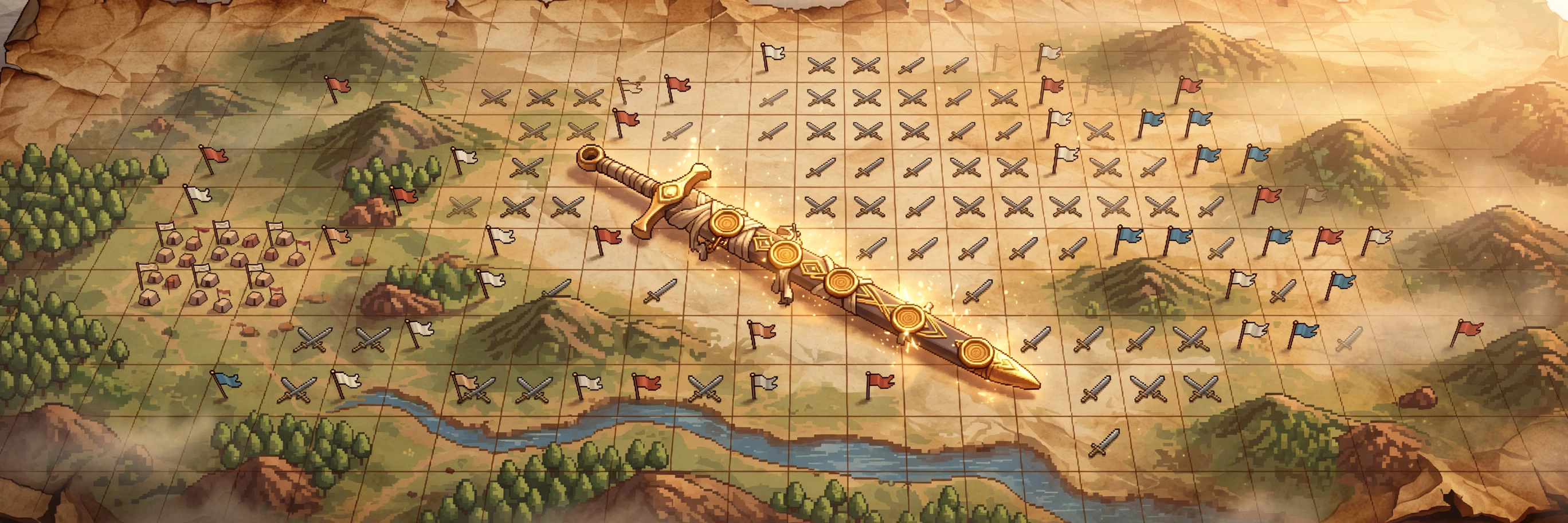
A fifteen-year-old lord who cannot promote until the story is nearly over, an army of 54 playable characters, and an ending that quietly locks itself away if you dawdle in the wrong chapter or let the wrong person fall. Fire Emblem: The Binding Blade — Fūin no Tsurugi, "The Sword of Seals" — was the series' first handheld entry and, for overseas players, the game they only knew as "Roy's game" for two decades. This is a deep strategy guide to the Japanese original: how its weapon triangles and support system actually work, the exact conditions that open all six gaiden chapters, how the Ilia and Sacae routes are really decided, and what it takes to reach the true ending beyond Chapter 22.
Quick facts
| Item | Detail |
|---|---|
| Original title | ファイアーエムブレム 封印の剣 (Fire Emblem: Fūin no Tsurugi) |
| English title | Fire Emblem: The Binding Blade (also rendered "The Sword of Seals") |
| Platform | Game Boy Advance |
| Release date (Japan) | March 29, 2002 (Japan only; no official overseas release of the GBA original) |
| Developer / Publisher | Intelligent Systems / Nintendo |
| Genre | Tactical role-playing game (grid-based, turn-based, permanent death) |
| Playable characters | 54 — the largest playable cast of the three GBA games |
| Chapters | 39 distinct chapter maps exist across both routes; a single run plays 25 main chapters plus up to 6 gaiden (sidequest) chapters |
Overview
The Binding Blade is set on Elibe, a continent humans have ruled since the Scouring — the ancient war against dragons, won with eight Divine Weapons that were then scattered across the land. When the kingdom of Bern invades its neighbours, Roy of Pherae, son of Eliwood, takes command of the Lycian army in his ailing father's place. What begins as a defensive war becomes a march across the whole continent: the Western Isles, the deserts of Nabata, the snows of Ilia or the plains of Sacae, and finally Bern itself.
Underneath the story sits a deliberately back-to-basics system set. There are no skills, no reclassing and no casual mode: a unit's class fixes its weapons and role, weapons break after a set number of uses, and a character who falls is gone for the rest of the game. Two systems carry the tactical weight. The first is the double triangle — swords, lances and axes in a physical cycle, and anima, light and dark magic in a magical one. The second is the support system in its modern form: this is the game that turned supports into something you build by keeping units adjacent and then activate through an on-map conversation, with each unit's elemental affinity deciding which stats a partner receives.
Structurally, the campaign is a chain of quiet tests. At two points the story splits into alternate routes and later reconverges. Six gaiden chapters hide the Divine Weapons. And Roy himself is the game's most famous constraint: the protagonist promotes only at the end of Chapter 21 (or 21x), so for most of the campaign your lord is a level-capped liability you must protect while everyone else grows around him.
Why It Still Matters
The Binding Blade matters first as a reset point. After the experimental, systems-heavy Thracia 776, this game rebuilt Fire Emblem around clarity — readable triangles, visible support conversations, a tutorial mode that was a first for the series — and it did so on a handheld, proving the series could live away from home consoles. Almost every GBA-era convention that The Blazing Blade and The Sacred Stones later exported to the world was designed here.
It also matters because its difficulty is honest. Enemy quality is high, hit rates are unforgiving, and the game repeatedly asks you to move fast on maps where moving fast is dangerous: thieves race you to treasure chests, and four of the true-ending gaiden chapters are locked behind turn limits (the chapters before 12x, 14x, 20x and 21x). A cleared game unlocks Hard Mode and the Trial Maps, so the cartridge keeps testing you after the credits. For players who met Roy only as a guest in other games, this is the campaign that explains him — a commander whose story is about carrying responsibility he is, mechanically as well as narratively, not yet strong enough for.
Highlights
- The support system, formalised. Adjacency earns points, a conversation raises the rank (C, B, A), and affinities shape the bonuses. Supports are this game's character writing and its finest stat engine at once.
- A campaign with side doors. Two route splits and six gaiden chapters mean two players' mid-games can look completely different — and the gaiden chapters are not filler, they are the true ending's skeleton.
- Roy's late promotion as design. Your lord is fragile for twenty chapters and then, armed with the Binding Blade, becomes one of the strongest boss-killers in the game. The arc is the story, expressed in numbers.
- Hard Mode and Trial Maps. Clearing the game once unlocks a genuinely sterner Hard Mode and standalone Trial Maps — substantial post-game value for a 2002 cartridge.
Strategy Essentials
1. The two triangles — the numbers underneath
Every combat forecast in this game starts with the triangles. In this game, holding the advantage grants +1 Attack and +10 Hit; being at disadvantage reverses both (−1 Attack and −10 Hit).
| Cycle | Beats | Beats | Beats |
|---|---|---|---|
| Physical | Swords beat axes | Axes beat lances | Lances beat swords |
| Magical (Trinity of Magic) | Anima beats light | Light beats dark | Dark beats anima |
Practical consequences. First, the triangle is why axe-heavy early enemy groups are a gift to your sword users and a threat to Lance-wielding Bors. Second, weapon rank (E through S) gates the best equipment, and rank grows only by using that weapon type — so decide early who your Durandal, Armads and Forblaze users will be, and feed them the right fights. Third, bows, staves and dragonstones sit outside the triangles: bow users are your safe answer to flying units, and Fae's dragonstone ignores the magical triangle entirely.
2. Supports — build them deliberately, not accidentally
Characters who end turns adjacent earn support points, and when enough have accumulated the pair can hold a support conversation on the map to raise their rank. Two limits shape your planning: the points a unit can earn in a single chapter are capped, so one map of standing still does not finish a support tree; and each character can only complete a limited number of conversations, so A-ranks are a scarce resource. Prioritise pairs who will actually fight side by side (Roy–Lilina is the classic), start building from the chapter a unit joins, and remember that support bonuses only apply when partners are within three squares of each other. Affinity decides the flavour of the bonus — Fire affinity leans offensive, Ice defensive, and so on — so a support plan is also a stat plan for your boss-killers.
3. The six gaiden chapters and the true ending — the checklist that decides your ending
Each gaiden chapter awards one Divine Weapon at its end. To unlock the chapters beyond Chapter 22 (Chapters 23, 24 and the Final Chapter), you must complete every gaiden chapter available on your route and still have every Divine Weapon — and the Binding Blade itself — unbroken at the end of Chapter 22. A Divine Weapon has limited uses; if one breaks before Chapter 22 ends, the true ending is gone for that run. Treat them as keys, not as everyday weapons.
| Gaiden | Divine Weapon | Unlock condition (in the preceding chapter) |
|---|---|---|
| 8x: The Blazing Blade | Durandal (sword) | Lilina must be alive at the end of Chapter 8 |
| 12x: The Thunder Axe | Armads (axe) | Finish Chapter 12 in 20 turns or fewer; if you took the B route through Chapters 10–11, Elffin must also be alive |
| 14x: The Infernal Truth | Forblaze (anima) | Finish Chapter 14 in 25 turns or fewer and keep Sophia alive * |
| 16x: The Glorious Ascension | Aureola (light) | Douglas must survive Chapter 16 — he is an enemy there; do not kill him |
| 20x: The Freezing Lance (Ilia route) | Maltet (lance) | Finish Chapter 20 on the Ilia route in 25 turns or fewer; Zelot and Juno must be recruited and alive |
| 20x: The Bow of Swift Wind (Sacae route) | Mulagir (bow) | Finish Chapter 20 on the Sacae route in 25 turns or fewer; Sue, Sin and Dayan must be recruited and alive |
| 21x: The Elder Revelation | Apocalypse (dark) | Finish Chapter 21 in 30 turns or fewer; Melady and Zeiss must both be recruited and alive |
\*A note on 14x: the specialist chapter-data sources used for this guide give a 25-turn limit for Chapter 14, while one older walkthrough lists 30 turns. Sources disagree, so plan as if 25 were the limit — finishing by turn 25 satisfies either figure.
The weapons that must remain unbroken to proceed beyond Chapter 22 are Durandal, Armads, Maltet, Mulagir, Forblaze, Aureola and Apocalypse, plus the Binding Blade. Yoder brings whichever of Maltet or Mulagir belongs to the route you did not take when he joins in Chapter 21, so the route split never locks you out of the required set. He also brings the Saint's Staff, but that staff is not a Divine Weapon: using it up does not prevent progression to Chapter 23. The Binding Blade itself is obtained at the end of Chapter 21/21x, at which point Roy finally promotes. For the best ending, Roy must land the killing blow on the final boss with the Binding Blade — keep its uses in reserve for exactly that.
Recruitment warnings tied to the table. Zeiss is recruited in Chapter 16 by Melady, so she must reach him before the enemy does. Douglas in Chapter 16 must be kept alive, not defeated: talking to him does not recruit him or stop him from attacking. Keep him alive until you seize the chapter — he joins at the start of 16x. To protect the rest of the army, use the fact that he will not attack Larum or Elffin: draw him into a side room or corridor and block the exit with Larum or Elffin, and keep fragile units out of his range. And because the 20x conditions are checked on characters recruited chapters earlier, the "keep alive" list above is a whole-campaign commitment, not a per-chapter task.
4. The two route splits — what actually decides them
| Split | When | How it is decided | What changes |
|---|---|---|---|
| Western Isles (A/B) | After Chapter 9 | Which village you visited in Chapter 9 (The Misty Isles) | Chapters 10–11 differ: the A route recruits Echidna and Larum; the B route recruits Bartre and Elffin. Both routes rejoin at Chapter 12 |
| Ilia route vs Sacae route | After Chapter 16 (or 16x) | Compare experience earned: if the combined experience earned by Sue and Sin is higher than that earned by Shanna and Thea, you go to Sacae; otherwise — including a tie — you go to Ilia. Experience counts even if one of the four has fallen | Chapters 17–20 and the 20x gaiden differ (Maltet on the Ilia route, Mulagir on the Sacae route), rejoining at Chapter 21 |
The Ilia/Sacae rule is the one players most often misread: it tracks experience earned by those four units across the whole campaign, not their levels or survival. If you want a specific route — Sacae is widely considered the harder of the two — you steer it simply by choosing which pair to deploy and feed experience to before Chapter 16. Note on naming: reference guides disagree on whether the Ilia or the Sacae chapters carry the "A" or "B" letter, so this guide names the routes Ilia and Sacae throughout rather than relying on the letter.
5. Playing Roy's campaign — habits that carry a run
- Protect the lord, feed the team. Roy must survive every map (his death is an instant defeat) but gains little from experience after level 20 until his late promotion. Give early kills to Alen, Lance, Dieck and Rutger instead.
- Race the thieves. Enemy thieves loot chests and then escape; treasure in this game is missable in a way later games softened. Chad, Astolfo and Cath are fast — use them, and recruit Cath by talking to her with Roy in each of her appearances.
- Budget weapon uses like money. Good weapons are scarce finds and funds are limited; save Divine Weapons for the ending checklist, and let iron and steel do the daily work.
- Plan promotion items. Promotion items are limited and classes promote with specific items; a small, focused team promoted on time beats a large roster stuck at level 20.
Who It's For
For tactical RPG players who want a demanding, legible game: every number that matters is on the forecast screen, and the challenge comes from positioning and resource discipline rather than hidden systems. For series historians, it is the missing link between the Super Famicom games and the GBA titles the West received — and Roy's own story. Players who rely on reclassing or casual modes should know in advance that those safety nets do not exist here, and there is no world map or free map you can revisit at will to level up: growth happens inside the chapters themselves, with the arena found in some chapters as the one risky in-chapter way to earn extra experience and gold.
How to Play It Today
The GBA original was released only in Japan, and it remains officially available in Japan through Nintendo's classic-game services: it was released for the Wii U Virtual Console in Japan on September 2, 2015, and added to Game Boy Advance – Nintendo Switch Online in Japan on June 23, 2023. The Japanese cartridge is also common on the second-hand market.
Find original hardware editions on eBay
As an eBay Partner Network affiliate, Enkeisha may earn a commission from qualifying purchases made through these links.
Search eBay listings (affiliate link)
Check the language, region, hardware compatibility, condition and authenticity before buying. Search results may include reproductions; links do not endorse individual sellers.