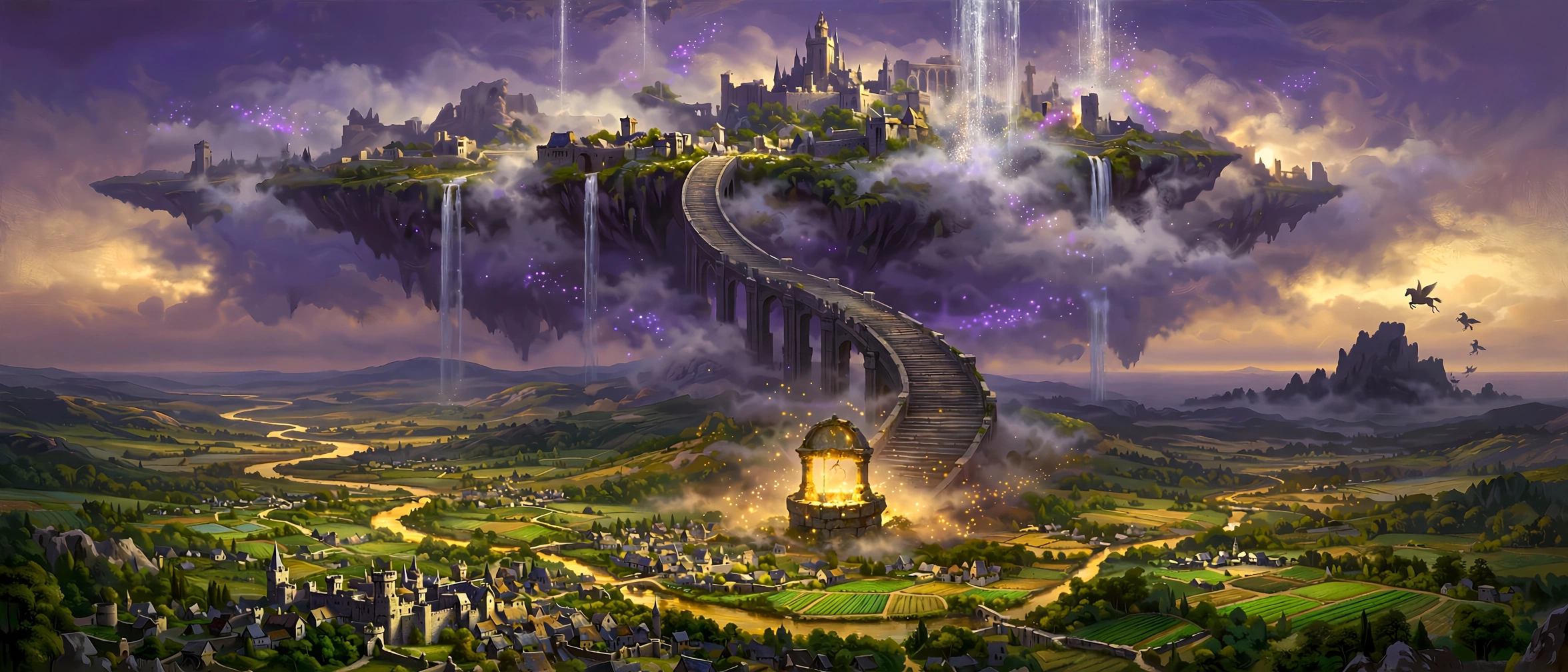
Every Dragon Quest sends you across a world. Dragon Quest VI: Maboroshi no Daichi — "The Phantom Land" — sends you across two of them, stacked on top of each other, and then asks an uncomfortable question: which one is real? Released for the Super Famicom in December 1995, it closed the Zenithian trilogy that IV and V had built, and it did so with the most elaborate character-building system the series had ever attempted: eighteen vocations, learned in battle, combined and mastered over the course of a very long journey.
It was also, for English-speaking players, the missing chapter. The original was never released outside Japan, and the first official English version arrived only fifteen years later, with the Nintendo DS remake of 2010–2011. This guide is about the 1995 original — and the distinction matters, because the remake quietly replaced one of its signature systems. In the Super Famicom game, defeated monsters can join your party as they did in Dragon Quest V, provided someone in the party is working as a Monster Master. In the DS version and its mobile ports, that random recruitment was removed entirely and replaced with a small cast of fixed, talkative slime companions. Play one version with the other's rules in mind and you will go looking for things that do not exist; what follows keeps the two apart throughout.
Quick Facts
| Item | Detail |
|---|---|
| Title (Japan) | Dragon Quest VI: Maboroshi no Daichi (ドラゴンクエストVI 幻の大地, "The Phantom Land") |
| English title | No English release of the Super Famicom original. The DS remake was titled Realms of Revelation in North America and Realms of Reverie in Europe and Australia |
| Platform | Super Famicom |
| Release (Japan) | December 9, 1995 |
| Developer | Heartbeat |
| Publisher | Enix |
| Genre | Role-playing game (turn-based) |
| Cartridge | 32 Mbit (4 MB), ROM + RAM + battery-backed save |
| Structure | Two parallel world maps (an upper "dream" world and a lower "real" world), plus a third, small realm for the finale |
| Battle party | Up to 4 active members, plus reserves in the wagon |
| Vocation system | 18 vocations: 9 basic, 6 advanced hybrids, 1 ultimate (Hero), 2 secret |
| Series position | Final game of the Zenithian (天空) trilogy, following Dragon Quest IV and V; last new mainline entry released for Super Famicom |
Overview
The game opens in mid-failure. The hero, the fighter Carver and the fortune-teller's granddaughter Milly ride a golden dragon toward the castle of the demon lord Murdaw — and are turned to stone for their trouble. The hero then wakes in the mountain village of Lifecod (Weaver's Peak in the remake), in a world where he has a sister, a home, and no memory of any of it. That world — the one the game starts in, the one that feels like home — is the dream. It is the Upper World, built from the dreams of the people of the Lower World, the real one. Early in the journey the party slips down a well into the real world and discovers the catch: down there, they are ghosts. Nobody can see them. Their real bodies are elsewhere — in Carver's case, standing petrified in Murdaw's own castle.
That inversion powers everything. Places destroyed by the demon lords in the real world survive intact in dreams, so the dream world becomes an archive of what was lost: Alltrades Abbey, the sealed town of Sorceria, the castle of King Zenith. Defeating Murdaw inside the dream does not kill him — it wakes the man he was possessing. The story is a long process of putting souls back into bodies, town by town and friend by friend, until both worlds can be defended together against the archfiend Mortamor, who intends to merge and swallow them.
Around that structure sit the systems that make this the densest 16-bit Dragon Quest. There is no day-and-night cycle; instead there are two complete world maps, a ship that eventually sails both — and dives beneath one of them — and a vocation system withheld until the first great arc is finished. Once Alltrades Abbey opens, the second half becomes a build-crafting exercise: characters are routed through chains of jobs, keeping every skill learned, toward the hybrid vocations that define the late game.
Why It Still Matters
Dragon Quest VI is the point where the series' two great experiments of the Super Famicom years — V's monster recruitment and III's class changing — were fused into a single design, and then pushed further than either. Vocations here are not the hard reset of Dragon Quest III, where changing class returned a character to level 1 and halved their stats. They work more like equipment for your character sheet: each one bends a character's stats by percentages, adds a set of skills and spells learned rank by rank through battle, and — crucially — everything learned is kept forever. Mastering two vocations unlocks a hybrid that combines their identities. The result is a system modern players will recognise as a job-combination tree, running on a 1995 cartridge.
It also completes a trilogy with unusual thematic discipline. IV was about a scattered cast converging; V was about one life across generations; VI is about identity itself — a hero who exists twice, a companion who exists only in dreams, victims who must be reassembled before they can fight. It is a handover point in the series' history, too: development moved from Chunsoft to Heartbeat, the cartridge doubled to 32 Mbit, and the production values visibly strain at what the hardware can do.
Highlights
- The two-world map as a puzzle box. Towns exist in both worlds with different people, different shops and different problems. A sealed door in one world may be rubble in the other; a drowned city in reality is alive in dreams. Exploration is constantly doubled, and the game trusts you to think in both maps at once.
- Vocations that reward planning, not grinding alone. Because skills are permanent and hybrids demand specific mastered pairs, the order in which you train a character is a genuine long-term decision — and the game gives you odd, characterful raw material, from a carpenter's son with enormous strength to a runaway mage who arrives at level 2.
- Monster recruitment, the Dragon Quest V way. With a Monster Master in the active party, defeated monsters from a limited roster may get up and join — including some of the strongest late-game recruits in the game. This system exists only in the Super Famicom original; the remake replaced it.
- A villain structure of sealed wounds. Each demon lord has not just occupied a place but erased it from one of the worlds, and restoring those places — a temple, a city of mages, a floating castle — is the game's real progress meter.
Strategy Essentials
The vocation system
Vocations open late by RPG standards: Alltrades Abbey is sealed by Murdaw, and it is only restored after you defeat the real Murdaw in the Lower World — the climax of the game's first great arc. Until then, characters grow by level alone. Once the abbey opens, every vocation has eight ranks, advanced by fighting battles in that vocation (battles against enemies far weaker than your party stop counting — rank progress has a level-based ceiling per area, so training must move to stronger territory as you level). Mastering a vocation means reaching rank 8. Skills and spells learned are kept permanently; the vocation itself applies percentage modifiers to the character's stats while it is held.
Basic vocations
| Vocation | Role | Representative abilities |
|---|---|---|
| Warrior | Front-line attacker | Falcon Slash (two strikes), Hatchet Man (high-risk critical swing) |
| Martial Artist | Fast physical attacker; raised critical rate | Knuckle Sandwich, Multifists |
| Mage | Offensive caster | Boom, Kasizzle, Bounce |
| Priest | Healer and buffer | Kabuff, Fullheal, Zing |
| Dancer | Evasion and disruption | Dodgy Dance, Death Dance |
| Thief | Utility; may steal after battle | Nose for Treasure, Padfoot |
| Merchant | Utility; earns extra gold after battle | Peep (appraises items) |
| Gadabout | Unpredictable trickster; may ignore orders | Comic and chance-based antics that occasionally turn a battle |
| Monster Master | Enabler of monster recruitment | Breath skills, Puff!; required in the active party for monsters to join |
Advanced vocations and their requirements
| Vocation | Requirement (vocations mastered) | Character of the job |
|---|---|---|
| Gladiator (Battlemaster) | Warrior + Martial Artist | The physical powerhouse; the standard destination for attackers |
| Armamentalist (Magic Knight) | Warrior + Mage | A sword arm with real magic: Oomph and top-tier fire spells such as Kafrizzle |
| Paladin | Martial Artist + Priest | Durable holy fighter with group protection skills such as Selflessness and Forbearance |
| Sage | Mage + Priest | The complete caster: Kazing, Kaboom, Multiheal, and reduced MP costs at higher ranks |
| Ranger | Thief + Monster Master + Merchant | The only three-mastery hybrid; fieldcraft and survival skills |
| Luminary (Superstar) | Dancer + Gadabout | Performer with the Hustle Dance for free group healing |
| Hero | Gladiator + Sage + Ranger + Luminary — the protagonist needs only one of the four | The ultimate vocation: balanced, self-sustaining, with automatic HP recovery in battle |
Secret vocations
| Vocation | Requirement |
|---|---|
| Dragon | Hold the Dragonic Diligence (a rare book item, consumed on use). The recruit Lizzie has this vocation by default |
| Liquid Metal Slime | Hold the Liquid Metal Mind (a rare book item, consumed on use). The recruit Mercury, a liquid metal slime, has it by default |
Two planning notes follow from the tables. First, the protagonist's discount on the Hero vocation is the game's biggest build shortcut: route him through one advanced job — Luminary is the fastest path, Gladiator or Sage the strongest — and he becomes a Hero while everyone else is still on their second job. Second, because recruitment requires a working Monster Master, someone in the party should hold that vocation through the middle game even if it is nobody's final destination; the Ranger path needs it mastered anyway.
Two worlds, and how you move between them
A naming caution first, because the remake's English terminology has blurred the original's geography. In the Super Famicom game, Japanese players call the pair the Upper World and the Lower World. The Upper World is the Dream World — the world the game begins in, built from the dreams of the people below. The Lower World is the Real World, which the dream's inhabitants call the "Phantom Land" (幻の大地) of the title. The remake's English materials use Real World / Dream World for the same pair. A third, separate map — the Dread Realm, Mortamor's own world — appears only at the end.
| World | What it is | What you do there |
|---|---|---|
| Upper World (Dream World) | A world formed by the dreams of the real world's people; slightly darker in palette. The hero's home village of Lifecod is here | The opening arc; the sealed places (Alltrades Abbey, Sorceria, Zenithia) survive here; dream-side counterparts of real-world bosses |
| Lower World (Real World) | The physical world, brighter in palette; the hero is the missing prince of Somnia (Reidock) here | The main campaign; ocean travel including an underwater map; the real Murdaw and the other demon lords |
| Dread Realm | A small, hostile realm created by Mortamor | The finale; reached only when the party's horse fuses with Pegasus and the party can fly |
| Stage | How travel opens up |
|---|---|
| Opening | On foot (and by horse and wagon) in the Dream World only |
| First descent | Wells and holes at paired locations drop the party into the Real World — where, as spirits, they are invisible until they obtain the means to be seen |
| After the dream Murdaw falls | Travel between worlds via wells and the great staircases on the world map becomes routine; events in one world begin opening paths in the other |
| The Ghent ship | Nevan and the Ghent clan's sacred ship give the party the sea in the Real World, and with it the road to the real Murdaw |
| Mid-game | The ship crosses both worlds; in the Real World the party can also travel beneath the sea |
| Endgame | The fused Pegasus opens the sky and the way into the Dread Realm |
The party, and the monsters
The fixed cast joins in a loose order — treat this as a guide to the journey's shape rather than a checklist, because several joins are gated by the two-world plot:
| Character | When (rough guide) | What they bring |
|---|---|---|
| The Hero | From the start | Balanced growth, the easy road to the Hero vocation; the party's anchor |
| Carver (Hassan) | Early — joins around Somnia in the Dream World | The strongest early physical attacker; high HP and strength, low MP and speed |
| Milly (Mireille) | Early — travels with the party from the opening arc | Healing and support spells; Terry's older sister |
| Ashlynn (Barbara) | Moonmirror Tower, met as a spirit while seeking the Mirror of Ra | The great offensive mage; joins at a very low level and must be protected while she catches up; the only member with no real-world body |
| Nevan (Chamoro) | Ghent, in the Real World, before the voyage to the real Murdaw | A dedicated healer whose arrival unlocks the sacred ship |
| Amos | Optional, at Scrimsley (Monstoru) | A solid physical recruit — missable: if you tell him the truth about his condition before bringing him the Seed of Reason, he leaves and can never join |
| Terry | Late — after the battle with Dhuran at the restored floating castle | A master swordsman. In the Super Famicom version he arrives having mastered Warrior only — though he already holds the Battlemaster vocation — which differs from the DS version (Warrior + Martial Artist mastered) and the mobile version (four basic vocations mastered), so do not plan his build from remake data |
| Lizzie (Drango) | After Terry joins — speak to the caged hacksaurus at Arkbolt with Terry present | A monster with dragon-class durability; the Dragon vocation by default |
Monster recruitment (Super Famicom original only). If a member of the active party is currently a Monster Master, a defeated monster from the recruitable roster may rise and join after battle, as in Dragon Quest V. The roster is deliberately small — the curated reference list names 17 species, while some Japanese guides count 18, so treat the exact total as listing-dependent — running from the humble Slime (joins readily) to the Liquid Metal Slime and the Overkilling Machine (both extremely reluctant). Standouts: the Slime Knight, an early recruit who can wear human-grade equipment; the Healslime, a tireless healer; and the Lips and Mud Mannequin, useful long-term spellcasters. Recruited slimes can also enter the slime arena contests. None of this exists in the remake, which substituted fixed slime NPCs who join by conversation, plus Lizzie by her story route. Slime Curling and tag mode are DS-remake additions, and the original has neither. Two features sometimes confused with this game are not part of Dragon Quest VI in any version: monster vocations — changing into monster jobs by using monster hearts — and immigrant-town building are Dragon Quest VII systems (immigrant towns also appear in the Dragon Quest IV remake). Dragon Quest VI's own vocations are the human vocations, including Monster Master, plus the secret Dragon and Liquid Metal Slime vocations opened with books.
Bosses and late-game equipment
Boss hit points and exact statistics vary between the original and the remake's data tables, so the table below gives the direction of each fight rather than numbers to plan around.
| Boss | Where it sits | Direction of the fight |
|---|---|---|
| Murdaw (dream) | Climax of the opening arc, in the Underkeep | Lower his defence and keep sustained healing; winning wakes the real king rather than ending the threat |
| Murdaw (real) | Murdaw's Keep, reached by the Ghent ship | The true first-arc finale. The Flame Claw found in his keep, used as an item, gives casters a reliable fire attack; guard against his debuffs and focus him down rather than chasing summoned help. Defeating him unseals Alltrades Abbey |
| Jamiras | After the gourd-island detour, guarding a sealed region | Acts twice on some turns and hits one target very hard with his talons; stack defence buffs, revive immediately, and do not let the fight become a war of attrition |
| Gracos | The undersea shrine, sealing Sorceria | A party-wide cold assault — freezing breath and ice magic. Breath-defence buffs and group healing matter more than raw damage; freeing Sorceria restores Ashlynn's home in the Dream World |
| Terry, then Dhuran | The floating castle, late game | Terry is a duel of swordsmen before the real fight. Dhuran strips your buffs with disruptive waves, so spend buffs sparingly and lean on skills that need no setup; winning restores Zenithia and brings Terry — and then Lizzie — to you |
| Mortamor | The Dread Realm, final battle | A multi-form finale; in the last form his two hands fight as separate targets alongside the body, and the support hand must not be left free to restore the others. Bring the party in advanced vocations and expect the longest fight in the game |
| Dark Dream (post-game) | Bonus dungeon, after the ending | The original's super-boss; a test of fully mastered builds rather than of levels alone |
Equipment to plan the endgame around
| Item | Attack | Who / notes |
|---|---|---|
| Falcon Blade | 67 | Strikes twice at reduced power per hit; a mid-to-late-game staple for fast attackers |
| Miracle Sword | 100 | Restores HP equal to a quarter of the damage dealt; keeps its user in the fight without a healer's turn |
| Sword of Ramias | 130, rising to 145 after reforging | Hero only; the legendary sword of the opening, recovered and twice reforged; used as an item in battle it casts Oomph |
| Metal King Sword | 130 | Equippable by everyone; found in the final dungeon; reliable against metal enemies |
| Orichalcum Fangs | 135 | Terry can equip them — the only human who can — and so can certain monster recruits. Not bought: they are found post-game, after taking a hint from a resident of Reaper's Peak |
| Gringham Whip | 145 | The strongest attack value in the game, and it strikes one group of enemies; hidden in the undersea treasure vault |
| Echo Hat (headgear) | — | Lets its wearer cast a spell twice; give it to your Sage and the group's healing and damage both double up |
Who It's For
Play this version if you read a job table the way other people read a menu. The vocation tree — nine basics, six hybrids, the Hero, and two secret jobs hiding behind rare books — is the real game, and it exists in full only alongside the original's monster recruitment. It also suits trilogy completists who want the Zenithian story in its original form, and anyone curious about Dragon Quest at the very end of its 16-bit run: confident, enormous, and willing to withhold its best system until a third of the story is over. If you simply want the story with modern conveniences, the remake is the kinder door — but it is a different game under the hood.
How to Play It Today
As of this writing (November 2026), the routes to Dragon Quest VI split by version, and it is worth being precise about which game each route actually gives you:
- The Super Famicom original (this article's version): never re-released on download services and never localised. The legitimate route is a second-hand Japanese cartridge — look for the 32 Mbit Enix release of December 1995.
- The Nintendo DS remake (2010 Japan / 2011 overseas): titled Realms of Revelation (North America) and Realms of Reverie (Europe/Australia); developed by ArtePiazza. Second-hand cartridges are common. Remember: no random monster recruitment in this version.
- iOS / Android (2015): Square Enix's mobile port, based on the DS remake, remains on sale in the app stores as of this writing. It is the easiest legal way to play the story in English, with the remake's rules throughout.
There is no announced modern-console port of either version as of this writing; check the stores again before buying hardware around it.
Related Reading
- Dragon Quest V: Hand of the Heavenly Bride (Super Famicom) — where monster recruitment began
- Dragon Quest IV (Famicom) — the first chapter of the Zenithian trilogy
- More Super Famicom RPG deep dives in this series
Editorial note: Basic specifications (internal title, capacity and memory configuration) are based on a check of the cartridge header information. The strategy content is based on published sources. No extracted images are used.
Find original hardware editions on eBay
As an eBay Partner Network affiliate, Enkeisha may earn a commission from qualifying purchases made through these links.
Search eBay listings (affiliate link)
Check the language, region, hardware compatibility, condition and authenticity before buying. Search results may include reproductions; links do not endorse individual sellers.